
Join Our JEE Preparation Group
Prep with like-minded aspirants; Get access to free daily tests and study material.
Sign in
Please select an account to continue using cracku.in
↓ →
Join Our JEE Preparation Group
Prep with like-minded aspirants; Get access to free daily tests and study material.
The number of integral values of m for which the quadratic expression $$(1 + 2m)x^2 - 2(1 + 3m)x + 4(1 + m)$$, $$x \in R$$, is always positive, is
We are given the quadratic expression
$$f(x)= (1+2m)x^{2}-2(1+3m)x+4(1+m), \qquad x\in \mathbb R.$$
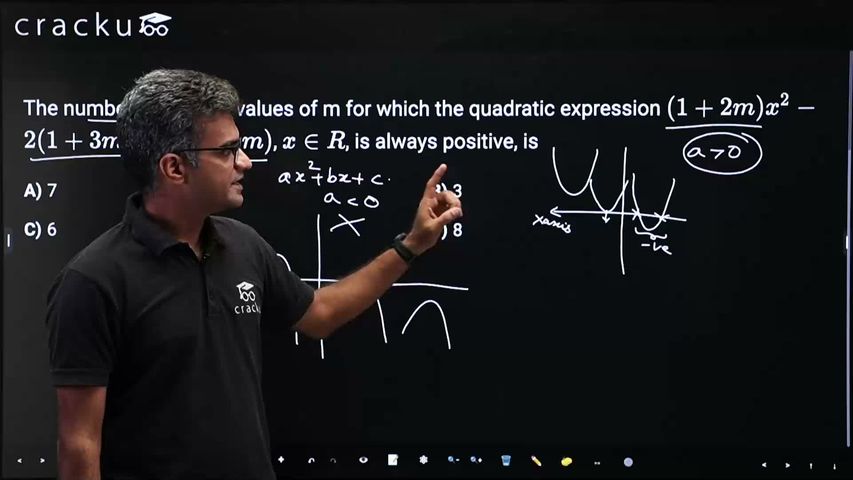
For every real value of $$x$$ the value of $$f(x)$$ must be positive. For a quadratic $$ax^{2}+bx+c$$ the following well-known facts hold:
• If $$a>0$$ and the discriminant $$D=b^{2}-4ac<0,$$ the parabola opens upward and has no real roots, so the quadratic is strictly positive for all $$x\in\mathbb R$$. • If $$a\le 0,$$ or if $$a>0$$ but $$D\ge 0,$$ the quadratic will touch or cross the $$x$$-axis somewhere, so it cannot stay positive everywhere.
Hence we must impose simultaneously
$$a=1+2m>0 \quad\text{and}\quad D<0.$$
Now we calculate the discriminant in detail. Here
$$a=1+2m,\qquad b=-2(1+3m),\qquad c=4(1+m).$$
First compute $$b^{2}$$:
$$b^{2}=\left[-2(1+3m)\right]^{2}=4(1+3m)^{2}=4\bigl(1+6m+9m^{2}\bigr).$$
Next compute the product $$4ac$$:
$$4ac=4\bigl(1+2m\bigr)\cdot 4(1+m)=16(1+2m)(1+m).$$
So the discriminant is
$$D=b^{2}-4ac=4\bigl(1+6m+9m^{2}\bigr)-16(1+2m)(1+m).$$
We factor the common $$4$$ out:
$$D=4\Bigl[(1+6m+9m^{2})-4(1+2m)(1+m)\Bigr].$$
Let us expand the bracket inside the big parentheses. First expand $$(1+2m)(1+m):$$
$$(1+2m)(1+m)=1(1+m)+2m(1+m)=1+m+2m+2m^{2}=1+3m+2m^{2}.$$
Multiply by $$4$$:
$$4(1+2m)(1+m)=4\bigl(1+3m+2m^{2}\bigr)=4+12m+8m^{2}.$$
Now perform the subtraction:
$$1+6m+9m^{2}-\bigl(4+12m+8m^{2}\bigr) =1-4+6m-12m+9m^{2}-8m^{2} =(-3)-6m+m^{2} =m^{2}-6m-3.$$
Therefore
$$D=4\bigl(m^{2}-6m-3\bigr).$$
For the quadratic to be always positive we need $$D<0$$, so
$$4\bigl(m^{2}-6m-3\bigr)<0 \;\Longrightarrow\; m^{2}-6m-3<0.$$
This is a quadratic inequality. First find its roots using the quadratic formula:
$$m=\frac{6\pm\sqrt{(-6)^{2}-4\cdot1\cdot(-3)}}{2} =\frac{6\pm\sqrt{36+12}}{2} =\frac{6\pm\sqrt{48}}{2} =\frac{6\pm4\sqrt3}{2} =3\pm2\sqrt3.$$
The coefficient of $$m^{2}$$ is positive, so the parabola opens upward and the expression $$m^{2}-6m-3$$ is negative between its roots. Hence
$$3-2\sqrt3<m<3+2\sqrt3.$$
We must also satisfy the earlier condition $$1+2m>0$$, i.e.
$$m>-\,\frac12.$$
Notice that
$$3-2\sqrt3\approx3-3.464\approx-0.464,$$
and $$-\,\dfrac12=-0.5$$ is slightly smaller. Therefore the tighter lower bound is $$m>3-2\sqrt3\;(\approx-0.464).$$ Combining the two conditions gives the single open interval
$$3-2\sqrt3<m<3+2\sqrt3\;\;(\approx-0.464<m<6.464).$$
The integral (integer) values of $$m$$ lying strictly inside this interval are
$$0,\,1,\,2,\,3,\,4,\,5,\,6.$$
That is a total of $$7$$ integers.
Hence, the correct answer is Option A.
Was this solution helpful?
Click on the Email ☝️ to Watch the Video Solution
Create a FREE account and get:
_1.webp)

Educational materials for JEE preparation

Ask our AI anything

AI can make mistakes. Please verify important information.
AI can make mistakes. Please verify important information.


