
Join Our JEE Preparation Group
Prep with like-minded aspirants; Get access to free daily tests and study material.
Sign in
Please select an account to continue using cracku.in
↓ →
Join Our JEE Preparation Group
Prep with like-minded aspirants; Get access to free daily tests and study material.
Let $$\left(-2 - \frac{1}{3}i\right)^3 = \frac{x+iy}{27}$$ $$(i = \sqrt{-1})$$, where $$x$$ and $$y$$ are real numbers then $$y - x$$ equals
We begin with the complex number $$\left(-2-\dfrac13\,i\right)$$ and we have to raise it to the third power. A very convenient first observation is that a common denominator of 3 can be taken out:
$$\left(-2-\dfrac13\,i\right)=\dfrac{-6-i}{3}.$$
Raising both sides to the third power gives
$$\left(-2-\dfrac13\,i\right)^3=\left(\dfrac{-6-i}{3}\right)^3=\dfrac{(-6-i)^3}{27}.$$
The question itself states that
$$\left(-2-\dfrac13\,i\right)^3=\dfrac{x+iy}{27},$$
so it is clear that we must evaluate $$(-6-i)^3$$; whatever real part and imaginary part we get will be the required $$x$$ and $$y$$ respectively.
To cube $$(-6-i)$$ we can first square it and then multiply once more by $$(-6-i)$$. Throughout, we keep the fundamental multiplication rule for complex numbers in mind:
$$ (a+ib)(c+id)=(ac-bd)+i(ad+bc). $$
Step 1: Calculate $$(-6-i)^2$$.
Using the ordinary algebraic expansion $$(A+B)^2=A^2+2AB+B^2$$ with $$A=-6$$ and $$B=-i$$,
$$(-6-i)^2=(-6)^2+2(-6)(-i)+(-i)^2.$$
Now compute each term carefully:
$$(-6)^2=36,$$
$$2(-6)(-i)=12i,$$
$$(-i)^2=i^2=(-1)= -1.$$
Adding them up,
$$(-6-i)^2=36+12i-1=35+12i.$$
Step 2: Multiply this square by $$(-6-i)$$ to obtain the cube.
We now multiply $$(35+12i)$$ by $$(-6-i)$$, applying the multiplication formula stated earlier. Identify
$$c=35,\quad d=12,\quad a=-6,\quad b=-1.$$
Then
$$\bigl(35+12i\bigr)\bigl(-6-i\bigr)=(ca-db)+i(cb+da).$$
Compute the real part first:
$$ca=35\times(-6)=-210,$$
$$db=12\times(-1)=-12,$$
$$ca-db=-210-(-12)=-210+12=-198.$$
Next compute the imaginary coefficient:
$$cb=35\times(-1)=-35,$$
$$da=12\times(-6)=-72,$$
$$cb+da=-35+(-72)=-107.$$
Thus
$$(-6-i)^3=-198-107\,i.$$
Step 3: Relate this to the required form.
Recall that
$$\left(-2-\dfrac13\,i\right)^3=\dfrac{(-6-i)^3}{27},$$
so substituting our result gives
$$\left(-2-\dfrac13\,i\right)^3=\dfrac{-198-107\,i}{27}.$$
Comparing this with the expression $$\dfrac{x+iy}{27}$$ we at once read off
$$x=-198,\qquad y=-107.$$
Step 4: Compute $$y-x$$.
$$y-x=(-107)-(-198)=-107+198=91.$$
Hence, the correct answer is Option A.
Was this solution helpful?
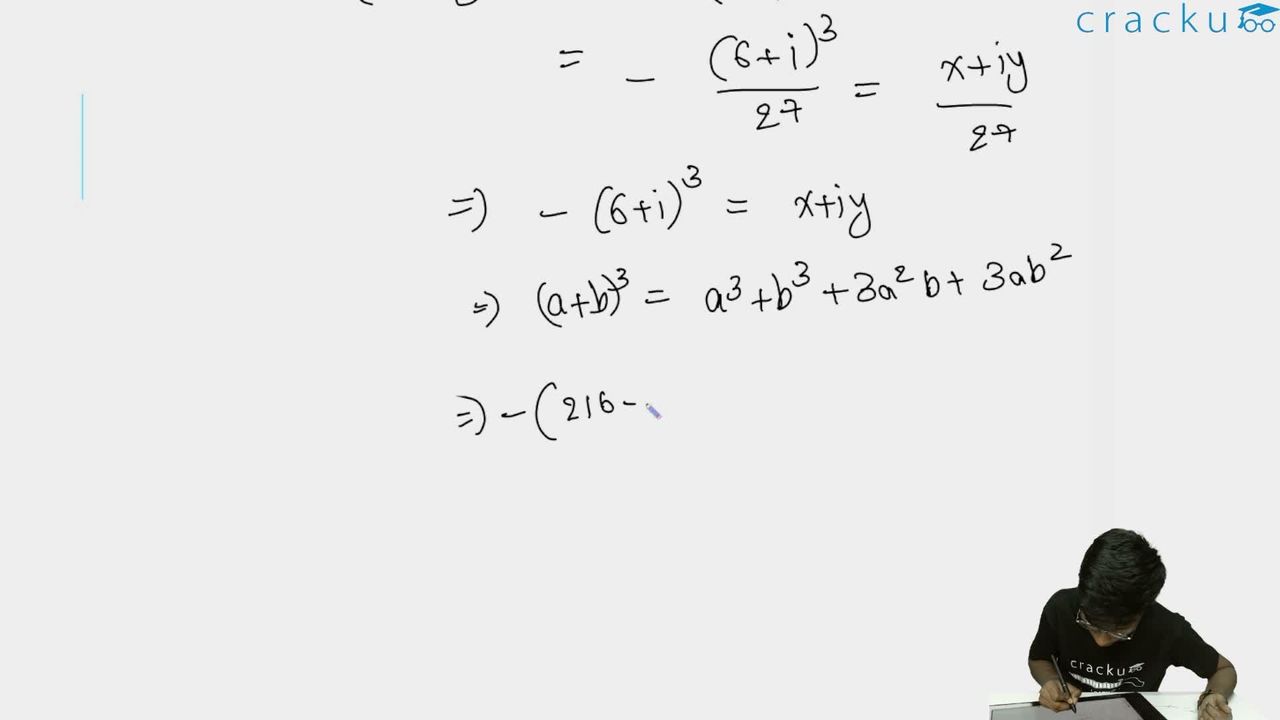
Click on the Email ☝️ to Watch the Video Solution
Create a FREE account and get:
_1.webp)

Educational materials for JEE preparation

Ask our AI anything

AI can make mistakes. Please verify important information.
AI can make mistakes. Please verify important information.
