
Join Our JEE Preparation Group
Prep with like-minded aspirants; Get access to free daily tests and study material.
Sign in
Please select an account to continue using cracku.in
↓ →
Join Our JEE Preparation Group
Prep with like-minded aspirants; Get access to free daily tests and study material.
If one real root of the quadratic equation $$81x^2 + kx + 256 = 0$$ is cube of the other root, then a value of k is:
We start with the quadratic equation $$81x^2 + kx + 256 = 0$$ whose two real roots we denote by $$\alpha$$ and $$\beta$$. According to the statement, one root is the cube of the other. We can therefore set
$$\beta = \alpha^3.$$
For any quadratic equation of the form $$ax^2 + bx + c = 0$$ we have the standard Vieta relations:
• Sum of the roots: $$\alpha + \beta = -\dfrac{b}{a}.$$
• Product of the roots: $$\alpha\beta = \dfrac{c}{a}.$$
In our particular equation $$a = 81,\; b = k,\; c = 256.$$ So the relations become
$$\alpha + \beta = -\dfrac{k}{81} \quad\text{and}\quad \alpha\beta = \dfrac{256}{81}.$$
Substituting $$\beta = \alpha^3$$ into the product relation gives
$$\alpha \cdot \alpha^3 = \dfrac{256}{81},$$
so
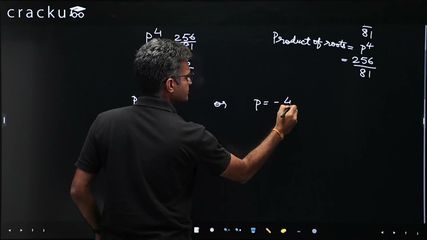
$$\alpha^4 = \dfrac{256}{81}.$$
We recognise that $$256 = 4^4$$ and $$81 = 3^4,$$ hence
$$\alpha^4 = \left(\dfrac{4}{3}\right)^4.$$
Taking the real fourth root on both sides, we obtain the two possible values
$$\alpha = \dfrac{4}{3} \quad\text{or}\quad \alpha = -\dfrac{4}{3}.$$
Now we use the sum relation $$\alpha + \beta = -\dfrac{k}{81}.$$ Remembering that $$\beta = \alpha^3,$$ we handle the two cases separately.
Case 1: $$\alpha = \dfrac{4}{3}.$$ Then $$\beta = \left(\dfrac{4}{3}\right)^3 = \dfrac{64}{27}.$$ Hence
$$\alpha + \beta = \dfrac{4}{3} + \dfrac{64}{27} = \dfrac{36}{27} + \dfrac{64}{27} = \dfrac{100}{27}.$$
Putting this into $$\alpha + \beta = -\dfrac{k}{81}$$ we get
$$\dfrac{100}{27} = -\dfrac{k}{81}.$$
Cross-multiplying gives
$$100 \times 81 = -27k,$$ so
$$k = -\dfrac{100 \times 81}{27} = -100 \times 3 = -300.$$
Case 2: $$\alpha = -\dfrac{4}{3}.$$ Then $$\beta = \left(-\dfrac{4}{3}\right)^3 = -\dfrac{64}{27}.$$ Thus
$$\alpha + \beta = -\dfrac{4}{3} - \dfrac{64}{27} = -\dfrac{36}{27} - \dfrac{64}{27} = -\dfrac{100}{27}.$$
Substituting into $$\alpha + \beta = -\dfrac{k}{81}$$ gives
$$-\dfrac{100}{27} = -\dfrac{k}{81}.$$
Canceling the negative signs we get
$$\dfrac{100}{27} = \dfrac{k}{81},$$
which leads to
$$k = \dfrac{100 \times 81}{27} = 100 \times 3 = 300.$$
Among the two values $$k = -300$$ and $$k = 300,$$ only $$-300$$ appears in the given list of options.
Hence, the correct answer is Option D.
Was this solution helpful?
Click on the Email ☝️ to Watch the Video Solution
Create a FREE account and get:
_1.webp)

Educational materials for JEE preparation

Ask our AI anything

AI can make mistakes. Please verify important information.
AI can make mistakes. Please verify important information.
