
Join Our JEE Preparation Group
Prep with like-minded aspirants; Get access to free daily tests and study material.
Sign in
Please select an account to continue using cracku.in
↓ →
Join Our JEE Preparation Group
Prep with like-minded aspirants; Get access to free daily tests and study material.
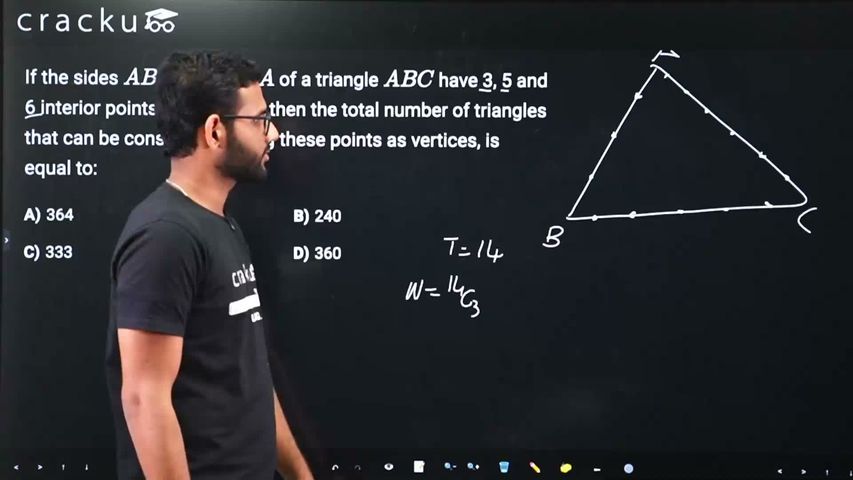
If the sides $$AB$$, $$BC$$ and $$CA$$ of a triangle $$ABC$$ have 3, 5 and 6 interior points respectively, then the total number of triangles that can be constructed using these points as vertices, is equal to:
The triangle $$ABC$$ has 3 interior points on side $$AB$$, 5 interior points on side $$BC$$, and 6 interior points on side $$CA$$. The question asks for triangles formed using these interior points as vertices, so there are $$3 + 5 + 6 = 14$$ points in total.
The total number of ways to choose 3 points from 14 is $$\binom{14}{3} = \frac{14 \times 13 \times 12}{6} = 364$$.
However, we must subtract the cases where all three chosen points are collinear, since collinear points do not form a triangle. Collinear points occur when all three points lie on the same side of the original triangle.
On side $$AB$$, there are 3 collinear points, giving $$\binom{3}{3} = 1$$ degenerate triple.
On side $$BC$$, there are 5 collinear points, giving $$\binom{5}{3} = 10$$ degenerate triples.
On side $$CA$$, there are 6 collinear points, giving $$\binom{6}{3} = 20$$ degenerate triples.
Therefore, the total number of valid triangles is $$364 - 1 - 10 - 20 = 333$$.
The correct answer is Option C: 333.
Was this solution helpful?
Click on the Email ☝️ to Watch the Video Solution
Create a FREE account and get:
_1.webp)

Educational materials for JEE preparation

Ask our AI anything

AI can make mistakes. Please verify important information.
AI can make mistakes. Please verify important information.


