
Join Our JEE Preparation Group
Prep with like-minded aspirants; Get access to free daily tests and study material.
Sign in
Please select an account to continue using cracku.in
↓ →
Join Our JEE Preparation Group
Prep with like-minded aspirants; Get access to free daily tests and study material.
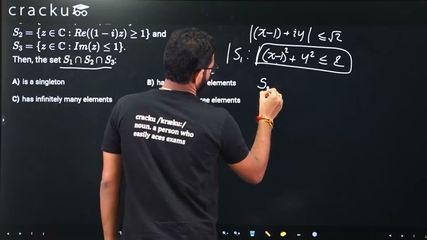
Let $$S_1, S_2$$ and $$S_3$$ be three sets defined as
$$S_1 = \{z \in \mathbb{C} : |z-1| \leq \sqrt{2}\}$$,
$$S_2 = \{z \in \mathbb{C} : Re((1-i)z) \geq 1\}$$ and
$$S_3 = \{z \in \mathbb{C} : Im(z) \leq 1\}$$.
Then, the set $$S_1 \cap S_2 \cap S_3$$:
Let $$z = x + iy$$. We need to find the intersection $$S_1 \cap S_2 \cap S_3$$.
For $$S_1$$: $$|z - 1| \leq \sqrt{2}$$ means $$(x-1)^2 + y^2 \leq 2$$. This is a closed disk centred at $$(1, 0)$$ with radius $$\sqrt{2}$$.
For $$S_2$$: $$\text{Re}((1-i)z) \geq 1$$. We compute $$(1-i)(x+iy) = x + iy - ix - i^2 y = (x+y) + i(y-x)$$. So $$\text{Re}((1-i)z) = x + y$$, and the condition becomes $$x + y \geq 1$$. This is the half-plane on and above the line $$x + y = 1$$.
For $$S_3$$: $$\text{Im}(z) \leq 1$$ means $$y \leq 1$$. This is the half-plane on and below the line $$y = 1$$.
Now we find the intersection. The line $$x + y = 1$$ intersects the circle $$(x-1)^2 + y^2 = 2$$. Substituting $$y = 1 - x$$ into the circle equation: $$(x-1)^2 + (1-x)^2 = 2$$, which gives $$2(x-1)^2 = 2$$, so $$(x-1)^2 = 1$$, meaning $$x = 0$$ or $$x = 2$$. The corresponding points are $$(0, 1)$$ and $$(2, -1)$$.
The line $$y = 1$$ intersects the circle: $$(x-1)^2 + 1 = 2$$, so $$(x-1)^2 = 1$$, giving $$x = 0$$ or $$x = 2$$. The points are $$(0, 1)$$ and $$(2, 1)$$.
The region $$S_1 \cap S_2 \cap S_3$$ is the part of the disk that lies above the line $$x + y = 1$$ and below the line $$y = 1$$. This is a closed region bounded by an arc of the circle from $$(0, 1)$$ to $$(2, -1)$$ (the upper arc), the line segment from $$(0, 1)$$ to $$(2, -1)$$ along $$x + y = 1$$, and capped at $$y = 1$$. Since the arc from $$(0,1)$$ to $$(2,1)$$ lies within $$y \leq 1$$ (the top of the circle is at $$y = \sqrt{2} \approx 1.414$$, which exceeds 1), the boundary also includes the line segment from $$(0,1)$$ to $$(2,1)$$ along $$y = 1$$.
This intersection region is a closed, bounded set with non-empty interior (it contains, for example, the point $$(1, 0.5)$$ which satisfies all three conditions). Since it has non-empty interior, it contains infinitely many elements.
The correct answer is Option C: has infinitely many elements.
Was this solution helpful?
Click on the Email ☝️ to Watch the Video Solution
Create a FREE account and get:
_1.webp)

Educational materials for JEE preparation

Ask our AI anything

AI can make mistakes. Please verify important information.
AI can make mistakes. Please verify important information.


