
Join Our JEE Preparation Group
Prep with like-minded aspirants; Get access to free daily tests and study material.
Sign in
Please select an account to continue using cracku.in
↓ →
Join Our JEE Preparation Group
Prep with like-minded aspirants; Get access to free daily tests and study material.
Given below are two statements:
Statement I: $$(CH_3)_3C^+$$ is more stable than $$CH_3^+$$ as nine hyperconjugation interactions are possible in $$(CH_3)_3C^+$$.
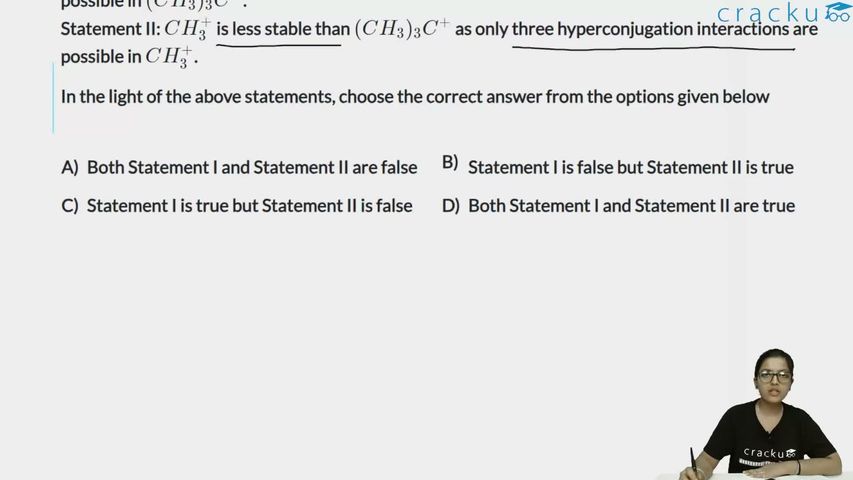
Statement II: $$CH_3^+$$ is less stable than $$(CH_3)_3C^+$$ as only three hyperconjugation interactions are possible in $$CH_3^+$$.
In the light of the above statements, choose the correct answer from the options given below
Hyperconjugation is a stabilizing effect in carbocations where electrons from the C-H bond adjacent to the carbocation carbon (alpha hydrogens) are donated into the empty p-orbital of the carbocation. The number of hyperconjugation interactions depends on the number of alpha hydrogens.
Consider the methyl carbocation, $$CH_3^+$$. The carbocation carbon has no alkyl groups attached, so there are no alpha carbons and hence no alpha hydrogens. Therefore, the number of hyperconjugation interactions in $$CH_3^+$$ is zero.
Now, consider the tert-butyl carbocation, $$(CH_3)_3C^+$$. The carbocation carbon is attached to three methyl groups. Each methyl group has three hydrogens, so the total number of alpha hydrogens is 3 × 3 = 9. Therefore, nine hyperconjugation interactions are possible.
Statement I claims that $$(CH_3)_3C^+$$ is more stable than $$CH_3^+$$ because it has nine hyperconjugation interactions. This is correct because more hyperconjugation interactions lead to greater stability. Thus, Statement I is true.
Statement II claims that $$CH_3^+$$ is less stable than $$(CH_3)_3C^+$$ because it has only three hyperconjugation interactions. However, as established, $$CH_3^+$$ has zero hyperconjugation interactions, not three. Therefore, Statement II is false.
In summary, Statement I is true and Statement II is false.
The correct option is C: Statement I is true but Statement II is false.
Was this solution helpful?
Click on the Email ☝️ to Watch the Video Solution
Create a FREE account and get:
_1.webp)

Educational materials for JEE preparation

Ask our AI anything

AI can make mistakes. Please verify important information.
AI can make mistakes. Please verify important information.
