
Join Our JEE Preparation Group
Prep with like-minded aspirants; Get access to free daily tests and study material.
Sign in
Please select an account to continue using cracku.in
↓ →
Join Our JEE Preparation Group
Prep with like-minded aspirants; Get access to free daily tests and study material.
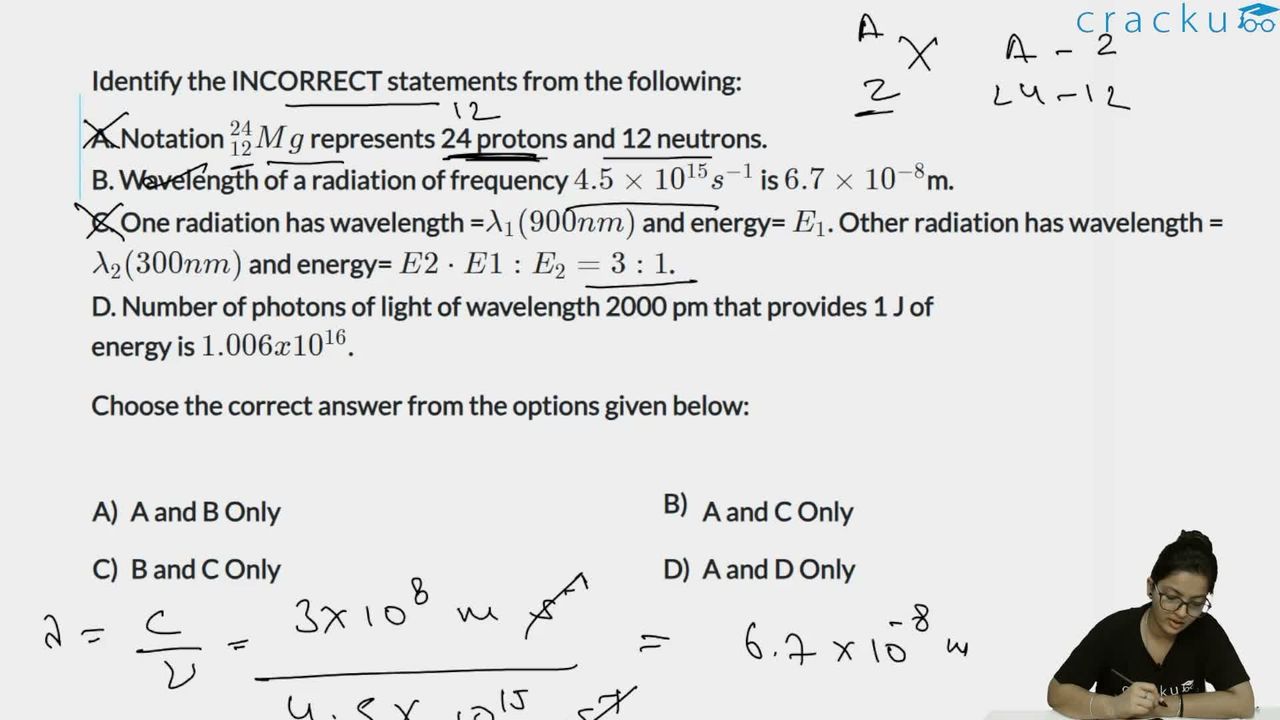
Identify the INCORRECT statements from the following:
A. Notation $$_{12}^{24}Mg$$ represents 24 protons and 12 neutrons.
B. Wavelength of a radiation of frequency $$ 4.5\times10^{15}s^{-1} $$ is $$ 6.7\times10^{-8} $$m.
C. One radiation has wavelength =$$\lambda_1(900nm) $$ and energy= $$E_{1}$$. Other radiation has wavelength = $$\lambda_2(300nm) $$ and energy= $$E2 \cdot E1 : E_2= 3 : 1$$.
D. Number of photons of light of wavelength 2000 pm that provides 1 J of
energy is $$1.006 x 10^{16}$$.
Choose the correct answer from the options given below:
We need to identify the INCORRECT statements from the given options about atomic structure.
Notation $$_{12}^{24}Mg$$ represents 24 protons and 12 neutrons. This is INCORRECT. In the notation $$_Z^A X$$, Z (subscript) = atomic number = number of protons = 12, and A (superscript) = mass number = 24. Number of neutrons = A - Z = 24 - 12 = 12. So it represents 12 protons and 12 neutrons, not 24 protons and 12 neutrons. ✗
Wavelength of radiation of frequency $$4.5 \times 10^{15} \, \text{s}^{-1}$$ is $$6.7 \times 10^{-8}$$ m. $$\lambda = c/\nu = 3 \times 10^8 / 4.5 \times 10^{15} = 6.67 \times 10^{-8}$$ m. This is CORRECT. ✓
$$\lambda_1 = 900$$ nm, $$\lambda_2 = 300$$ nm. $$E_1 : E_2 = 3 : 1$$. Since $$E = hc/\lambda$$, we get $$E_1/E_2 = \lambda_2/\lambda_1 = 300/900 = 1/3$$, so $$E_1 : E_2 = 1 : 3$$, not $$3 : 1$$. This is INCORRECT. ✗
Number of photons of wavelength 2000 pm providing 1 J of energy is $$1.006 \times 10^{16}$$. $$E_{\text{photon}} = hc/\lambda = 6.63 \times 10^{-34} \times 3 \times 10^8 / (2000 \times 10^{-12}) = 9.945 \times 10^{-17}$$ J.
$$n = 1 / 9.945 \times 10^{-17} = 1.006 \times 10^{16}$$. This is CORRECT. ✓
Incorrect statements are A and C.
The correct answer is Option (2): A and C Only.
Was this solution helpful?
Click on the Email ☝️ to Watch the Video Solution
Create a FREE account and get:
_1.webp)

Educational materials for JEE preparation

Ask our AI anything

AI can make mistakes. Please verify important information.
AI can make mistakes. Please verify important information.
