
Join Our JEE Preparation Group
Prep with like-minded aspirants; Get access to free daily tests and study material.
Sign in
Please select an account to continue using cracku.in
↓ →
Join Our JEE Preparation Group
Prep with like-minded aspirants; Get access to free daily tests and study material.
For all $$z \in C$$ on the curve $$C_1$$: $$|z| = 4$$, let the locus of the point $$z + \dfrac{1}{z}$$ be the curve $$C_2$$. Then
To find the correct statement regarding the relationship between the curves $$C_1$$ and $$C_2$$, we derive the Cartesian equation of the locus curve $$C_2$$ from the given circle $$C_1$$ and perform a direct geometrical comparison.
Let $$z \in \mathbf{C}$$ be a point on the curve $$C_1$$ defined by:
$$|z| = 4$$
In polar form, any point on this circle can be represented as:
$$z = 4e^{i\theta} = 4(\cos\theta + i\sin\theta)$$
---
Step 1: Derive the equation of the curve $$C_2$$
Let the points on the locus curve $$C_2$$ be represented by the complex variable $$w = x + iy$$. Given the transformation:
$$w = z + \frac{1}{z}$$
Substituting the polar form of $$z$$:
$$x + iy = 4e^{i\theta} + \frac{1}{4e^{i\theta}} = 4e^{i\theta} + \frac{1}{4}e^{-i\theta}$$
Using Euler's formula ($$e^{\pm i\theta} = \cos\theta \pm i\sin\theta$$), we expand the terms:
$$x + iy = 4(\cos\theta + i\sin\theta) + \frac{1}{4}(\cos\theta - i\sin\theta)$$
Separating this into real and imaginary parts gives:
$$x = \left(4 + \frac{1}{4}\right)\cos\theta = \frac{17}{4}\cos\theta \implies \cos\theta = \frac{4x}{17}$$
$$y = \left(4 - \frac{1}{4}\right)\sin\theta = \frac{15}{4}\sin\theta \implies \sin\theta = \frac{4y}{15}$$
Eliminating the parameter $$\theta$$ using the identity $$\cos^2\theta + \sin^2\theta = 1$$:
$$\left(\frac{4x}{17}\right)^2 + \left(\frac{4y}{15}\right)^2 = 1 \implies \frac{x^2}{\left(\frac{17}{4}\right)^2} + \frac{y^2}{\left(\frac{15}{4}\right)^2} = 1$$
Thus, the curve $$C_2$$ is an ellipse with a semi-major axis $$a = \frac{17}{4}$$ and a semi-minor axis $$b = \frac{15}{4}$$.
---
Step 2: Geometrical Comparison of Dimensions
The curve $$C_1$$ is a circle centered at the origin with radius $$R = 4$$.
The curve $$C_2$$ is an ellipse centered at the origin with semi-major axis $$a = \frac{17}{4} = 4.25$$ and semi-minor axis $$b = \frac{15}{4} = 3.75$$.
Comparing these dimensions directly:
$$b < R < a$$
$$3.75 < 4 < 4.25$$
---
Step 3: Conclusion
Since both curves are symmetric and centered at the origin, the fact that the circle's radius $$R$$ lies strictly between the semi-minor axis $$b$$ and the semi-major axis $$a$$ of the ellipse ensures that the two curves must cross each other.
Specifically, the circle extends further out than the ellipse along the y-axis ($$R > b$$), while the ellipse extends further out than the circle along the x-axis ($$a > R$$). This dimensional layout forces the curves to cross each other exactly once in each of the four quadrants.
Therefore, the correct statement is that the curves $$C_1$$ and $$C_2$$ intersect at 4 points.
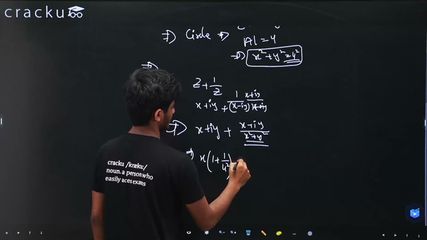
Click on the Email ☝️ to Watch the Video Solution
Create a FREE account and get:
_1.webp)

Educational materials for JEE preparation

Ask our AI anything

AI can make mistakes. Please verify important information.
AI can make mistakes. Please verify important information.


