
Join Our JEE Preparation Group
Prep with like-minded aspirants; Get access to free daily tests and study material.
Sign in
Please select an account to continue using cracku.in
↓ →
Join Our JEE Preparation Group
Prep with like-minded aspirants; Get access to free daily tests and study material.
The number of integral solution $$x$$ of $$\log_{x + \frac{7}{2}}\left(\frac{x-7}{2x-3}\right)^2 \geq 0$$ is
For the logarithm to be defined,
$$x+\frac72>0,$$
$$x+\frac72\ne1,$$
and
$$\left(\frac{x-7}{2x-3}\right)^2>0.$$
Thus,
$$x>-\frac72,\qquad x\ne-\frac52,\qquad x\ne\frac32,\qquad x\ne7.$$
Since $$x$$ is an integer,
$$x\ge-3,$$
with
$$x\ne-2,\ 7.$$
Now consider the base.
$$x+\frac72>1$$
$$x>-\frac52.$$
For an integer,
$$x\ge-2.$$
Since the base is greater than $$1$$,
$$\log_aN\ge0\iff N\ge1.$$
Hence,
$$\left(\frac{x-7}{2x-3}\right)^2\ge1.$$
This gives
$$|x-7|\ge|2x-3|.$$
Squaring,
$$(x-7)^2\ge(2x-3)^2.$$
$$x^2-14x+49\ge4x^2-12x+9.$$
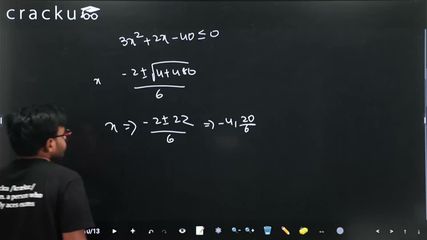
$$3x^2+2x-40\le0.$$
$$(3x-10)(x+4)\le0.$$
Hence,
$$-4\le x\le\frac{10}{3}.$$
Since
$$x\ge-2,$$
the integral values are
$$-1,\ 0,\ 1,\ 2,\ 3.$$
(Note that $$x=-2$$ is excluded because the base becomes $$\frac32$$? Actually $$x=-2$$ makes the base $$\frac32$$ but the argument is defined; however, $$x=-2$$ was excluded earlier since $$x+\frac72=1.5$$? The excluded value is $$x=-\frac52$$, so $$x=-2$$ is allowed.)
Thus the integral values are
$$-2,\ -1,\ 0,\ 1,\ 2,\ 3.$$
$$0<x+\frac72<1.$$
This requires
$$-\frac72<x<-\frac52,$$
which contains no integer.
Hence there are no solutions from this case.
Therefore, the total number of integral solutions is
$$6.$$
Hence,
$$\boxed{6}$$
Was this solution helpful?
Click on the Email ☝️ to Watch the Video Solution
Create a FREE account and get:
_1.webp)

Educational materials for JEE preparation

Ask our AI anything

AI can make mistakes. Please verify important information.
AI can make mistakes. Please verify important information.
