
Join Our JEE Preparation Group
Prep with like-minded aspirants; Get access to free daily tests and study material.
Sign in
Please select an account to continue using cracku.in
↓ →
Join Our JEE Preparation Group
Prep with like-minded aspirants; Get access to free daily tests and study material.
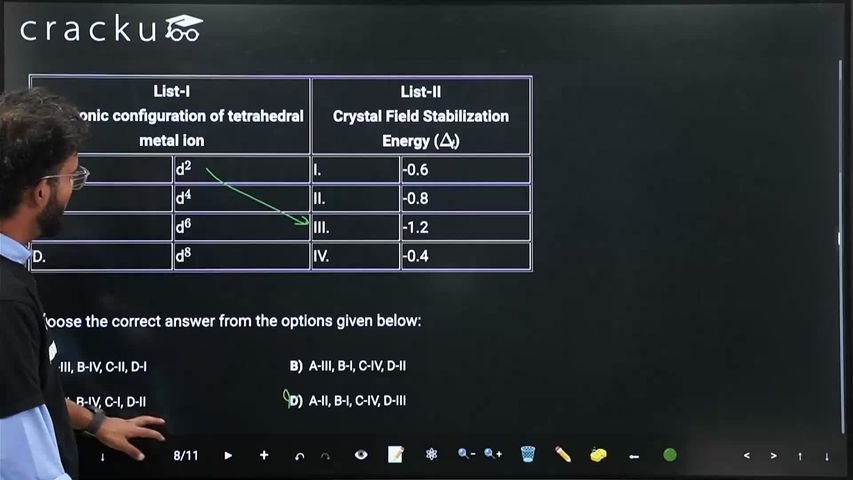
Match the LIST-I with LIST-II
| List-I Electronic configuration of tetrahedral metal ion | List-II Crystal Field Stabilization Energy ($$\Delta_t$$) | ||
|---|---|---|---|
| A. | d$$^2$$ | I. | -0.6 |
| B. | d$$^4$$ | II. | -0.8 |
| C. | d$$^6$$ | III. | -1.2 |
| D. | d$$^8$$ | IV. | -0.4 |
Choose the correct answer from the options given below:
For tetrahedral complexes, the (e) orbitals are stabilized by (0.6\Delta_t) and the (t_2) orbitals are destabilized by (0.4\Delta_t). Therefore, the Crystal Field Stabilization Energy (CFSE) is given by
$$\text{CFSE}=[n(e)(-0.6)+n(t_2)(+0.4)]\Delta_t.$$
For a (d^2) configuration, the electron distribution is (e^2t_2^0). Hence,
$$\text{CFSE}=2(-0.6)\Delta_t+0(+0.4)\Delta_t=-1.2\Delta_t,$$
which corresponds to III.
For a (d^4) configuration, the electron distribution is (e^2t_2^2). Thus,
$$\text{CFSE}=2(-0.6)\Delta_t+2(+0.4)\Delta_t=-1.2\Delta_t+0.8\Delta_t=-0.4\Delta_t,$$
which corresponds to IV.
For a (d^6) configuration, the electron distribution is (e^3t_2^3). Therefore,
$$\text{CFSE}=3(-0.6)\Delta_t+3(+0.4)\Delta_t=-1.8\Delta_t+1.2\Delta_t=-0.6\Delta_t,$$
which corresponds to I.
For a (d^8) configuration, the electron distribution is (e^4t_2^4). Hence,
$$\text{CFSE}=4(-0.6)\Delta_t+4(+0.4)\Delta_t=-2.4\Delta_t+1.6\Delta_t=-0.8\Delta_t,$$
which corresponds to II.
Thus, the correct matching is
$$A\rightarrow III,\qquad B\rightarrow IV,\qquad C\rightarrow I,\qquad D\rightarrow II.$$
Hence, the correct sequence is A-III, B-IV, C-I, D-II.
Was this solution helpful?
Click on the Email ☝️ to Watch the Video Solution
Create a FREE account and get:
_1.webp)

Educational materials for JEE preparation

Ask our AI anything

AI can make mistakes. Please verify important information.
AI can make mistakes. Please verify important information.


