
Join Our JEE Preparation Group
Prep with like-minded aspirants; Get access to free daily tests and study material.
Sign in
Please select an account to continue using cracku.in
↓ →
Join Our JEE Preparation Group
Prep with like-minded aspirants; Get access to free daily tests and study material.
The major product (A) formed in the following reaction sequence is:
Nitrobenzene $$\xrightarrow{(i) Sn, HCl}$$ $$\xrightarrow{(ii) Ac_2O, Pyridine}$$ $$\xrightarrow{(iii) Br_2, AcOH}$$ $$\xrightarrow{(iv) NaOH(aq)}$$ A
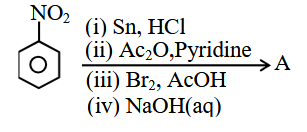
To determine the major product $$A$$ of the given reaction sequence, we analyze the transformation occurring at each stage. This sequence is a standard method for synthesizing para-substituted aniline derivatives while preventing unwanted polysubstitution.
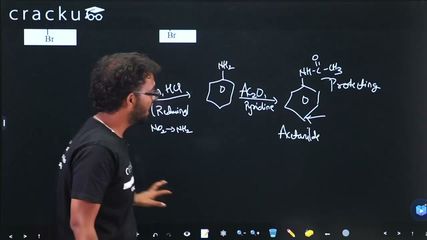
The starting compound is nitrobenzene. Treatment with $$Sn/HCl$$ reduces the nitro group $$(-NO_2)$$ to an amino group $$(-NH_2)$$, producing aniline.
The aniline formed is then treated with acetic anhydride $$\left(Ac_2O\right)$$ in the presence of pyridine. This reaction acetylates the amino group to form acetanilide. The acetyl group acts as a protecting group, reducing the strong activating effect of the amino group and thereby preventing tribromination during the subsequent bromination step.
When acetanilide is treated with $$Br_2$$ in acetic acid, electrophilic aromatic substitution takes place. The acetamido group $$(-NHCOCH_3)$$ is an ortho/para-directing group. However, because of steric hindrance near the ortho positions, bromination occurs predominantly at the para position, yielding para-bromoacetanilide as the major product.
Finally, hydrolysis with aqueous $$NaOH$$ removes the acetyl protecting group, regenerating the amino functionality. This converts para-bromoacetanilide into para-bromoaniline.
Thus, the overall sequence is
$$\text{Nitrobenzene} \xrightarrow{Sn/HCl} \text{Aniline} \xrightarrow{Ac_2O,;Pyridine} \text{Acetanilide} \xrightarrow{Br_2,;AcOH} p\text{-Bromoacetanilide} \xrightarrow{NaOH(aq)} p\text{-Bromoaniline}.$$
Therefore, the major product $$A$$ is para-bromoaniline, in which the $$-NH_2$$ and $$-Br$$ groups are positioned para to each other on the benzene ring.
Hence, the correct answer is $$p$$-bromoaniline, corresponding to the first option.
Was this solution helpful?
Click on the Email ☝️ to Watch the Video Solution
Create a FREE account and get:
_1.webp)

Educational materials for JEE preparation

Ask our AI anything

AI can make mistakes. Please verify important information.
AI can make mistakes. Please verify important information.
