
Join Our JEE Preparation Group
Prep with like-minded aspirants; Get access to free daily tests and study material.
Sign in
Please select an account to continue using cracku.in
↓ →
Join Our JEE Preparation Group
Prep with like-minded aspirants; Get access to free daily tests and study material.
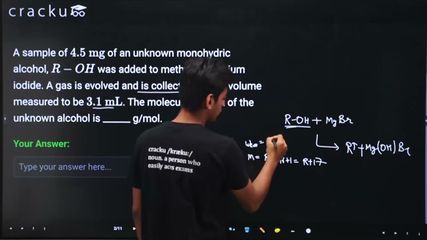
A sample of $$4.5 \text{ mg}$$ of an unknown monohydric alcohol, $$R-OH$$ was added to methylmagnesium iodide. A gas is evolved and is collected and its volume measured to be $$3.1 \text{ mL}$$. The molecular weight of the unknown alcohol is ______ g/mol.
Correct Answer: 33
The balanced chemical equation for the Zerewitinoff determination is:
$$\mathrm{R-OH + CH_3MgI \longrightarrow CH_4\uparrow + R-OMgI}$$
From the stoichiometry of the reaction:
$$\mathrm{1\ mol\ Alcohol \longrightarrow 1\ mol\ CH_4}$$
Volume of methane evolved:
$$\mathrm{3.1\ mL}$$
Molar volume of gas:
$$\mathrm{22700\ mL\ mol^{-1}}$$
Moles of methane evolved:
$$\mathrm{Moles\ of\ CH_4 = \frac{3.1}{22700}}$$
Since the molar ratio is $$\mathrm{1:1}$$:
$$\mathrm{Moles\ of\ R-OH = \frac{3.1}{22700}\ mol}$$
Mass of alcohol given:
$$\mathrm{4.5\ mg = 4.5\times10^{-3}\ g}$$
Molecular weight of alcohol:
$$\mathrm{Molecular\ Weight = \frac{Mass}{Moles}}$$
$$\mathrm{= \frac{4.5\times10^{-3}}{\frac{3.1}{22700}}}$$
$$\mathrm{= \frac{4.5\times10^{-3}\times22700}{3.1}}$$
$$\mathrm{= \frac{102.15}{3.1}}$$
$$\mathrm{\approx 32.95\ g\ mol^{-1}}$$
Rounding to the nearest whole number:
$$\boxed{\mathrm{33\ g\ mol^{-1}}}$$
Was this solution helpful?
Click on the Email ☝️ to Watch the Video Solution
Create a FREE account and get:
_1.webp)

Educational materials for JEE preparation

Ask our AI anything

AI can make mistakes. Please verify important information.
AI can make mistakes. Please verify important information.
