
Join Our JEE Preparation Group
Prep with like-minded aspirants; Get access to free daily tests and study material.
Sign in
Please select an account to continue using cracku.in
↓ →
Join Our JEE Preparation Group
Prep with like-minded aspirants; Get access to free daily tests and study material.
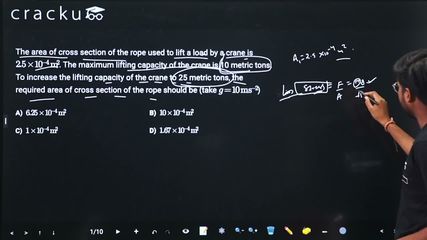
The area of cross section of the rope used to lift a load by a crane is $$2.5 \times 10^{-4} \text{ m}^2$$. The maximum lifting capacity of the crane is 10 metric tons. To increase the lifting capacity of the crane to 25 metric tons, the required area of cross section of the rope should be (take $$g = 10 \text{ m s}^{-2}$$)
We need to determine the required area of cross-section of the crane's rope to increase its maximum lifting capacity from 10 metric tons to 25 metric tons.
The maximum lifting capacity of a rope depends on the maximum permissible stress ($$\sigma$$) the material can withstand without breaking. Stress is defined as the restoring force per unit cross-sectional area:
$$\text{Stress } (\sigma) = \frac{\text{Force}}{\text{Area}} = \frac{mg}{A}$$
Since the material of the rope remains the same, the maximum permissible stress stays constant ($$\sigma_1 = \sigma_2$$). Therefore, the lifting load ($$m$$) is directly proportional to the cross-sectional area ($$A$$):
$$\frac{m_1}{A_1} = \frac{m_2}{A_2}$$
From the problem
Rearranging the proportion formula to isolate the new required area ($$A_2$$):
$$A_2 = A_1 \times \left(\frac{m_2}{m_1}\right)$$
$$A_2 = (2.5 \times 10^{-4}\text{ m}^2) \times \frac{25}{10}$$
$$A_2 = 2.5 \times 10^{-4} \times 2.5 = 6.25 \times 10^{-4}\text{ m}^2$$
The required area of cross-section of the rope should be $$6.25 \times 10^{-4}\text{ m}^2$$, which corresponds to Option A.
Was this solution helpful?
Click on the Email ☝️ to Watch the Video Solution
Create a FREE account and get:
_1.webp)

Educational materials for JEE preparation

Ask our AI anything

AI can make mistakes. Please verify important information.
AI can make mistakes. Please verify important information.
