
Join Our JEE Preparation Group
Prep with like-minded aspirants; Get access to free daily tests and study material.
Sign in
Please select an account to continue using cracku.in
↓ →
Join Our JEE Preparation Group
Prep with like-minded aspirants; Get access to free daily tests and study material.
If the ratio of lengths, radii and Young's moduli of steel and brass wires in the figure are a, b and c respectively, then the corresponding ratio of increase in their lengths is :
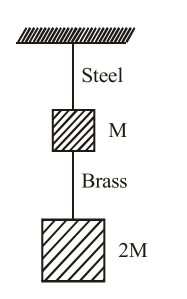
Tension in Brass wire ($$F_b$$): It supports only the bottom mass $$2M$$, hence, $$F_b = 2Mg$$
Tension in Steel wire ($$F_s$$): It supports both masses $$M$$ and $$2M$$, hence, $$F_s = Mg + 2Mg = 3Mg$$
$$\frac{F_s}{F_b} = \frac{3Mg}{2Mg} = \frac{3}{2}$$
$$\Delta L = \frac{FL}{AY} = \frac{FL}{\pi r^2 Y}$$
$$\frac{\Delta L_s}{\Delta L_b} = \left( \frac{F_s}{F_b} \right) \times \left( \frac{L_s}{L_b} \right) \times \left( \frac{r_b}{r_s} \right)^2 \times \left( \frac{Y_b}{Y_s} \right)$$
$$\frac{\Delta L_s}{\Delta L_b} = \left( \frac{3}{2} \right) \times (a) \times \left( \frac{1}{b} \right)^2 \times \left( \frac{1}{c} \right)$$
$$\frac{\Delta L_s}{\Delta L_b} = \frac{3a}{2b^2c}$$
Was this solution helpful?
Create a FREE account and get:
_1.webp)

Educational materials for JEE preparation

Ask our AI anything

AI can make mistakes. Please verify important information.
AI can make mistakes. Please verify important information.


