
Join Our JEE Preparation Group
Prep with like-minded aspirants; Get access to free daily tests and study material.
Sign in
Please select an account to continue using cracku.in
↓ →
Join Our JEE Preparation Group
Prep with like-minded aspirants; Get access to free daily tests and study material.
The gravitational field, due to the 'left over part' of a uniform sphere (from which a part as shown, has been 'removed out'), at a very far off point, P, located as shown, would be (nearly) :
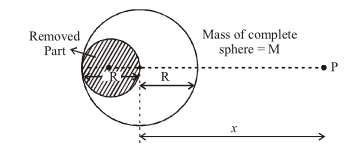
Mass of removed part, $$m = \frac{\text{Volume of removed part}}{\text{Volume of whole sphere}} \times M = \frac{\frac{4}{3}\pi (R/2)^3}{\frac{4}{3}\pi R^3} \times M = \frac{M}{8}$$
The gravitational field $$E$$ at a distance $$x$$ from a point mass (or a uniform sphere at a far point) is $$E = \frac{GM}{x^2}$$.
Since $$P$$ is at a distance $$x$$ from the center, $$E_{total} = \frac{GM}{x^2}$$.
$$E_{removed} \approx \frac{G(M/8)}{x^2}$$
$$E_{net} = E_{total} - E_{removed}$$
$$E_{net} \approx \frac{GM}{x^2} - \frac{GM}{8x^2}$$
$$E_{net} \approx \left(1 - \frac{1}{8}\right) \frac{GM}{x^2} = \mathbf{\frac{7}{8} \frac{GM}{x^2}}$$
Was this solution helpful?
Create a FREE account and get:
_1.webp)

Educational materials for JEE preparation

Ask our AI anything

AI can make mistakes. Please verify important information.
AI can make mistakes. Please verify important information.


