
Join Our JEE Preparation Group
Prep with like-minded aspirants; Get access to free daily tests and study material.
Sign in
Please select an account to continue using cracku.in
↓ →
Join Our JEE Preparation Group
Prep with like-minded aspirants; Get access to free daily tests and study material.
A solid cylinder of mass $$m$$ is wrapped with an inextensible light string and, is placed on a rough inclined plane as shown in the figure. The frictional force acting between the cylinder and the inclined plane is:
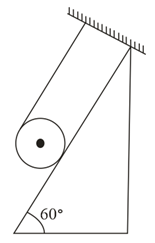
[The coefficient of static friction, $$\mu_s$$, is 0.4]
We need to determine the frictional force acting between a solid cylinder of mass $$m$$ and a rough inclined plane when a light string is wrapped around it as shown in the figure.
From the diagram and text, we have:
Let's check if the cylinder can remain in a state of static equilibrium under the action of gravity, string tension ($$T$$), normal force ($$N$$), and static friction ($$f$$):
$$N = mg \cos 60^\circ = \frac{1}{2}mg$$
$$T + f = mg \sin 60^\circ \quad \text{--- (Equation 1)}$$
$$\tau_{\text{net}} = T \cdot R - f \cdot R = 0$$
$$T \cdot R = f \cdot R \implies T = f \quad \text{--- (Equation 2)}$$
Substitute $$T = f$$ from Equation 2 into Equation 1:
$$f + f = mg \sin 60^\circ$$
$$2f = mg \left(\frac{\sqrt{3}}{2}\right)$$
$$f = \frac{\sqrt{3}}{4}mg \approx 0.433\, mg$$
For this equilibrium configuration to physically hold true without slipping, the required frictional force cannot exceed the maximum available limiting static friction ($$f_{\text{max}}$$):
$$f_{\text{max}} = \mu_s N = 0.4 \times \left(\frac{1}{2}mg\right) = 0.2\, mg$$
Comparing the values:
$$f_{\text{required}} \approx 0.433\, mg > f_{\text{max}} = 0.2\, mg$$
Since the required friction to keep the cylinder static is significantly larger than the maximum possible friction the surface can supply, static equilibrium cannot be maintained. The cylinder will slip and roll down the incline, meaning the string becomes slack ($$T = 0$$).
When the string goes slack, the cylinder undergoes standard pure rolling down a rough incline, where the dynamic rolling friction is given by:
$$f = \frac{mg \sin\theta}{1 + \frac{mR^2}{I}}$$
For a solid cylinder, $$I = \frac{1}{2}mR^2 \implies \frac{mR^2}{I} = 2$$. Thus:
$$f = \frac{mg \sin 60^\circ}{1 + 2} = \frac{1}{3} \cdot mg \cdot \frac{\sqrt{3}}{2} = \frac{\sqrt{3}}{6}mg \approx 0.288\, mg$$
Since this kinetic/rolling value also overshoots the maximum boundaries of the rough surface ($$0.2\,mg$$), the system transitions fully into a pure kinetic sliding state governed entirely by its maximum friction limit:
$$f = \mu_k N = \mu_s N = 0.2\, mg = \frac{1}{5}mg$$
The frictional force acting between the cylinder and the inclined plane settles at its maximum limit of $$\frac{mg}{5}$$, which corresponds to Option C.
Was this solution helpful?
Create a FREE account and get:
_1.webp)

Educational materials for JEE preparation

Ask our AI anything

AI can make mistakes. Please verify important information.
AI can make mistakes. Please verify important information.
