
Join Our JEE Preparation Group
Prep with like-minded aspirants; Get access to free daily tests and study material.
Sign in
Please select an account to continue using cracku.in
↓ →
Join Our JEE Preparation Group
Prep with like-minded aspirants; Get access to free daily tests and study material.
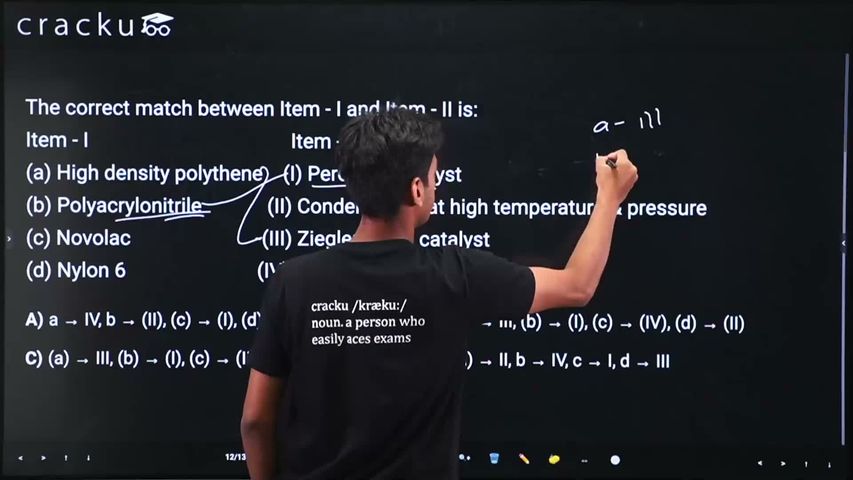
The correct match between Item - I and Item - II is:
Item - I Item - II
(a) High density polythene (I) Peroxide catalyst
(b) Polyacrylonitrile (II) Condensation at high temperature & pressure
(c) Novolac (III) Ziegler-Natta catalyst
(d) Nylon 6 (IV) Acid or base catalyst
We start by recalling how each of the given polymers is manufactured and which catalyst or reaction condition is characteristically employed.
High density polythene, commonly abbreviated as HDPE, is obtained by polymerising ethene in the presence of the well-known Ziegler-Natta catalyst, a mixture of $$\text{TiCl}_4$$ and $$\text{(C}_2\text{H}_5)_3\text{Al}$$. So we can write the correspondence as
High density polythene}\; \longrightarrow \; \text{Ziegler-Natta catalyst (III)
Polyacrylonitrile, abbreviated as PAN, is produced by the free-radical polymerisation of acrylonitrile. A peroxide such as benzoyl peroxide or hydrogen peroxide supplies these free radicals. Therefore, the link is
Polyacrylonitrile}\; \longrightarrow \; \text{Peroxide catalyst (I)
Novolac is a phenol-formaldehyde resin formed by the condensation of phenol with formaldehyde when an acid or a base acts as the catalyst. Thus, we have
$$\text{Novolac} \; \longrightarrow \;$$ Acid or base catalyst (IV)
Nylon 6 is synthesised by the ring-opening polymerisation (a step-growth process) of $$\epsilon$$-caprolactam. This polymerisation is carried out at a high temperature of about $$533 \text{ K}$$ and a pressure of roughly $$10^4 \text{ Pa}$$, so it is categorised as condensation at high temperature and pressure. Hence,
Nylon 6}\; \longrightarrow \; \text{Condensation at high temperature \& pressure (II)
Collecting all four pairings, we obtain
$$\begin{aligned} (a)&: \text{HDPE} &\rightarrow&\; (III) \\ (b)&: \text{Polyacrylonitrile} &\rightarrow&\; (I) \\ (c)&: \text{Novolac} &\rightarrow&\; (IV) \\ (d)&: \text{Nylon 6} &\rightarrow&\; (II) \end{aligned}$$
Looking at the given options, this exact sequence corresponds to Option B.
Hence, the correct answer is Option B.
Was this solution helpful?
Click on the Email ☝️ to Watch the Video Solution
Create a FREE account and get:
_1.webp)

Educational materials for JEE preparation

Ask our AI anything

AI can make mistakes. Please verify important information.
AI can make mistakes. Please verify important information.
