
Join Our JEE Preparation Group
Prep with like-minded aspirants; Get access to free daily tests and study material.
Sign in
Please select an account to continue using cracku.in
↓ →
Join Our JEE Preparation Group
Prep with like-minded aspirants; Get access to free daily tests and study material.
Given below are two statements :
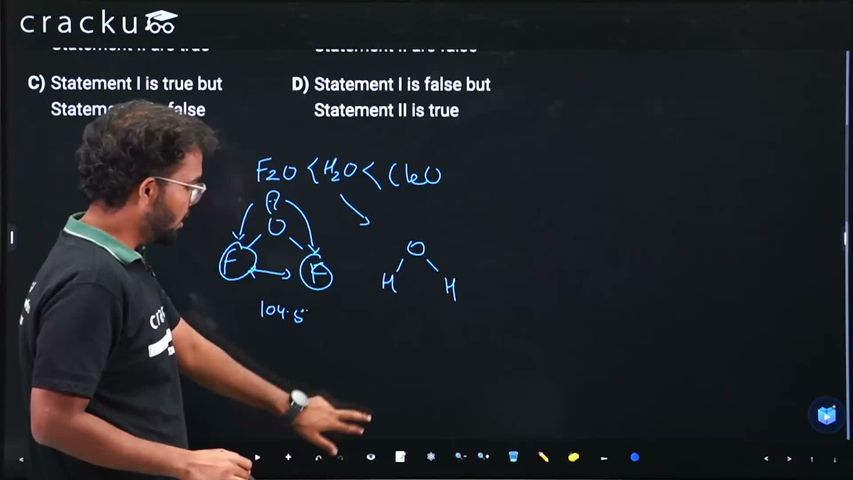
Statement I : $$F_2O < H_2O < Cl_2O$$ is the correct trend in terms of bond angle.
Statement II : SiF$$_4$$, SnF$$_4$$ and PbF$$_4$$ are ionic in nature.
In the light of the above statements, choose the correct answer from the options given below :
For (F_2O), the highly electronegative fluorine atoms attract the bonding electron pairs towards themselves, reducing the bond pair-bond pair repulsion around the central oxygen atom. As a result, the bond angle is approximately (103^\circ).
In (H_2O), the bond angle is about (104.5^\circ), which is the typical value for a bent molecule with two lone pairs on an (sp^3)-hybridized oxygen atom.
In (Cl_2O), chlorine is less electronegative and larger in size than fluorine. The increased steric repulsion between the bulky chlorine atoms leads to a larger bond angle of about (111^\circ).
Hence, the bond angle order is
$$F_2O<H_2O<Cl_2O.$$
Therefore, Statement I is true.
(SiF_4) is a covalent molecular compound. Similarly, (SnF_4) and (PbF_4) are predominantly covalent tetrahalides rather than ionic compounds. According to Fajans' rule, these tetrafluorides possess significant covalent character and cannot be classified as ionic.
Therefore, Statement II is false.
Hence, Statement I is true, Statement II is false, and the correct answer is Option C.
Was this solution helpful?
Click on the Email ☝️ to Watch the Video Solution
Create a FREE account and get:
_1.webp)

Educational materials for JEE preparation

Ask our AI anything

AI can make mistakes. Please verify important information.
AI can make mistakes. Please verify important information.
