
Join Our JEE Preparation Group
Prep with like-minded aspirants; Get access to free daily tests and study material.
Sign in
Please select an account to continue using cracku.in
↓ →
Join Our JEE Preparation Group
Prep with like-minded aspirants; Get access to free daily tests and study material.
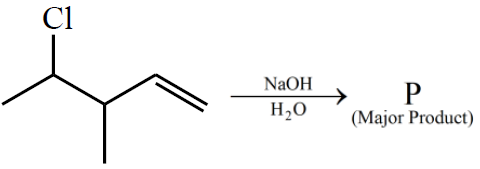
Consider the above reaction. The number of $$\pi$$ electrons present in the product 'P' is ______
Correct Answer: 2
The reaction proceeds through an $$\mathrm{S_N1}$$ mechanism because the solvent $$\mathrm{H_2O}$$ is polar protic.
First, the chloride ion leaves, generating a secondary carbocation.
To attain greater stability, a $$\mathrm{1,2\text{-}Hydride\ Shift}$$ occurs from the adjacent tertiary allylic carbon.
This forms a more stable tertiary allylic carbocation stabilized by resonance and inductive effects.
The nucleophile $$\mathrm{OH^-}$$ then attacks the carbocation to form the alcohol product.
The final product retains one carbon-carbon double bond.
A double bond contains:
$$\mathrm{1\ \sigma\ bond\ and\ 1\ \pi\ bond}$$
Each covalent bond contains two electrons.
Hence, the number of $$\mathrm{\pi}$$ electrons present in product $$\mathrm{P}$$ is:
$$\mathrm{2}$$
Correct Answer: $$\mathrm{2}$$
Was this solution helpful?
Click on the Email ☝️ to Watch the Video Solution
Create a FREE account and get:
_1.webp)

Educational materials for JEE preparation

Ask our AI anything

AI can make mistakes. Please verify important information.
AI can make mistakes. Please verify important information.
