
Join Our JEE Preparation Group
Prep with like-minded aspirants; Get access to free daily tests and study material.
Sign in
Please select an account to continue using cracku.in
↓ →
Join Our JEE Preparation Group
Prep with like-minded aspirants; Get access to free daily tests and study material.
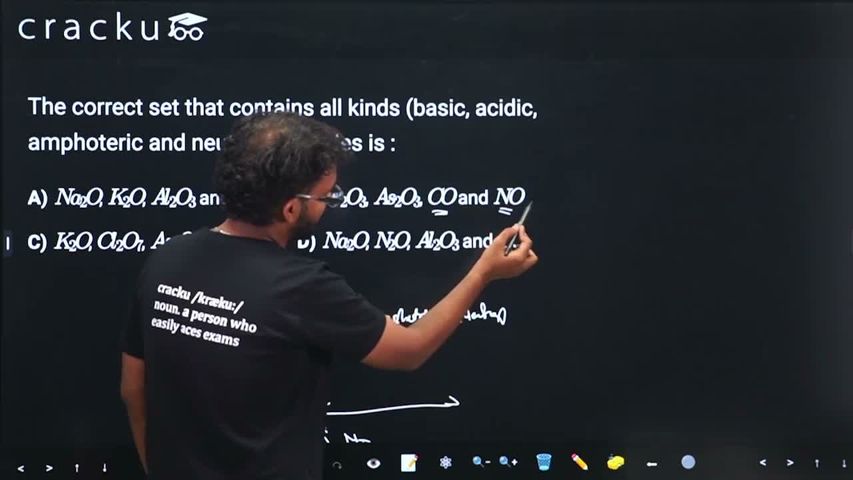
The correct set that contains all kinds (basic, acidic, amphoteric and neutral) of oxides is :
An oxide is classified as:
• Basic oxide - reacts with acids to give salt + water.
• Acidic oxide - reacts with bases to give salt + water (often an anhydride of an oxy-acid).
• Amphoteric oxide - reacts with both acids and bases.
• Neutral oxide - shows neither basic nor acidic behaviour (does not react with either dilute acids or dilute bases).
We need one oxide of each type in the same option.
Checking Option C : $$K_2O,\, Cl_2O_7,\, As_2O_3,\, NO$$
1. $$K_2O$$ - metal oxide of an alkali metal. It dissolves in water giving $$2KOH$$, a strong base. Hence it is a basic oxide.
2. $$Cl_2O_7$$ - highest oxide of chlorine; in water it forms $$2HClO_4$$. Therefore it is the anhydride of perchloric acid and behaves as a very strong acidic oxide.
3. $$As_2O_3$$ - reacts with dilute $$HCl$$ (forming $$AsCl_3$$) and also dissolves in alkali (forming arsenites). Thus it shows dual behaviour and is an amphoteric oxide.
4. $$NO$$ - does not react with either dilute acids or dilute bases and therefore is a neutral oxide.
All four kinds are present, so Option C is correct.
Why the other options fail
• Option A: $$Na_2O$$ and $$K_2O$$ are both basic, $$Al_2O_3$$ amphoteric, $$As_2O_3$$ mainly acidic/amphoteric. No neutral oxide present.
• Option B: $$Al_2O_3$$ amphoteric, $$As_2O_3$$ acidic/amphoteric, $$CO$$ neutral, $$NO$$ neutral. No basic oxide present.
• Option D: $$Na_2O$$ basic, $$Al_2O_3$$ amphoteric, $$N_2O$$ neutral, $$CO$$ neutral. No acidic oxide present.
Therefore, the only set containing all four kinds of oxides is:
Option C which is: $$K_2O$$, $$Cl_2O_7$$, $$As_2O_3$$ and $$NO$$
Was this solution helpful?
Click on the Email ☝️ to Watch the Video Solution
Create a FREE account and get:
_1.webp)

Educational materials for JEE preparation

Ask our AI anything

AI can make mistakes. Please verify important information.
AI can make mistakes. Please verify important information.
