
Join Our JEE Preparation Group
Prep with like-minded aspirants; Get access to free daily tests and study material.
Sign in
Please select an account to continue using cracku.in
↓ →
Join Our JEE Preparation Group
Prep with like-minded aspirants; Get access to free daily tests and study material.
Given below are two statements :
Statement I : The second ionization enthalpy of B, Al and Ga is in the order of $$B > Al > Ga$$.
Statement II : The correct order in terms of first ionization enthalpy is $$Si < Ge < Pb < Sn$$.
In the light of the above statements, choose the correct answer from the options given below:
First recall the definition: the $$n^{\text{th}}$$ ionization enthalpy is the energy required to remove the $$n^{\text{th}}$$ electron after the previous $$(n-1)$$ electrons have already been removed.
Hence for second ionization enthalpy we must look at the species $$M^{+}$$, not the neutral atom.
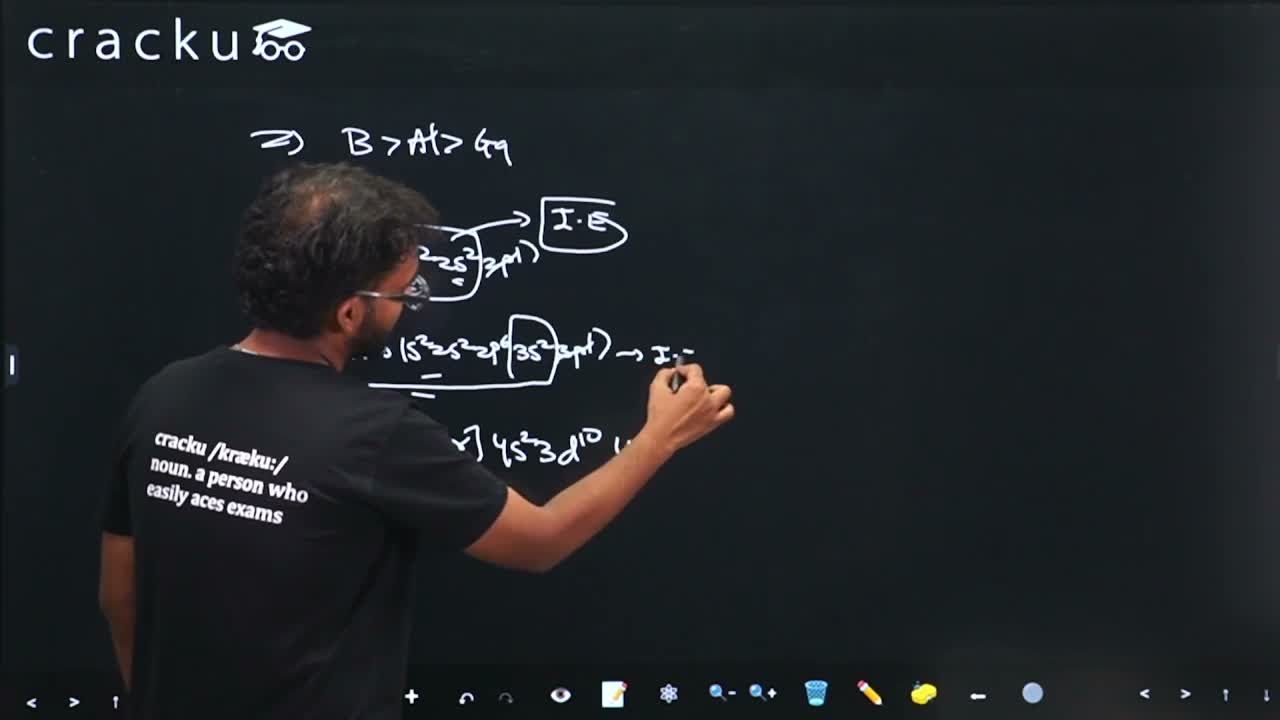
Statement I: “The second ionization enthalpy of $$B,\;Al$$ and $$Ga$$ is in the order $$B \gt Al \gt Ga$$”.
Electronic configurations and their singly-charged cations are
$$B : 1s^{2}\;2s^{2}\;2p^{1} \;\;\;\; \rightarrow \;\;\; B^{+} : 1s^{2}\;2s^{2}$$
$$Al : [Ne]\;3s^{2}\;3p^{1} \;\;\;\; \rightarrow \;\;\; Al^{+} : [Ne]\;3s^{2}$$
$$Ga : [Ar]\;3d^{10}\;4s^{2}\;4p^{1} \;\;\;\; \rightarrow \;\;\; Ga^{+} : [Ar]\;3d^{10}\;4s^{2}$$
Actual experimental values ($$kJ mol^{-1}$$):
$$IE_2(B)=2427,\; IE_2(Al)=1817,\; IE_2(Ga)=1979$$.
Order: $$B \gt Ga \gt Al$$, not $$B \gt Al \gt Ga$$.
Hence Statement I is false.
Statement II: “The correct order of first ionization enthalpy is $$Si \lt Ge \lt Pb \lt Sn$$”.
Move down group 14 (Si, Ge, Sn, Pb):
The atomic size increases, so ionization enthalpy generally decreases; however, poor shielding by $$d$$ and $$f$$ electrons causes a small rise from Sn to Pb.
Experimental $$IE_1$$ values ($$kJ mol^{-1}$$):
$$Si=786,\; Ge=762,\; Sn=709,\; Pb=715$$
So the increasing (lowest → highest) order is
$$Sn \lt Pb \lt Ge \lt Si$$, while the decreasing (highest → lowest) order is
$$Si \gt Ge \gt Pb \gt Sn$$.
The sequence given in Statement II, $$Si \lt Ge \lt Pb \lt Sn$$, is exactly opposite to the facts, therefore Statement II is also false.
Because both statements are incorrect, the correct choice is:
Option B $$\longrightarrow\ $$ Both Statement I and Statement II are false.
Was this solution helpful?
Click on the Email ☝️ to Watch the Video Solution
Create a FREE account and get:
_1.webp)

Educational materials for JEE preparation

Ask our AI anything

AI can make mistakes. Please verify important information.
AI can make mistakes. Please verify important information.
