Join WhatsApp Icon JEE WhatsApp Group
Question 57

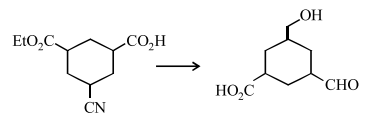
The reagent(s) required for the following conversion are:
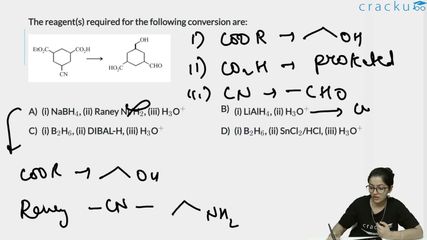
  • $$\text{--CO}_2\text{Et (Ester)} \rightarrow \text{--CH}_2\text{OH (Primary Alcohol)}$$ : Reduced
  • $$\text{--CO}_2\text{H (Carboxylic Acid)} \rightarrow \text{--CO}_2\text{H (Carboxylic Acid)}$$ : Protected / Unchanged
  • $$\text{--CN (Nitrile)} \rightarrow \text{--CHO (Aldehyde)}$$ : Reduced selectively to an aldehyde

Detailed Evaluation of Each Option:

  • Option A: (i) $$\text{NaBH}_4$$, (ii) Raney $$\text{Ni/H}_2$$, (iii) $$\text{H}_3\text{O}^+$$

    • $$\text{NaBH}_4$$ is a mild reducing agent that generally does not reduce esters, carboxylic acids, or nitriles under standard conditions. Thus, step (i) will fail to convert the ester to an alcohol.
    • Raney $$\text{Ni/H}_2$$ reduces nitrile ($$-\text{CN}$$) groups completely down to primary amines ($$-\text{CH}_2\text{NH}_2$$), not aldehydes ($$-\text{CHO}$$).
    • Result: Incorrect transformation products.

  • Option B: (i) $$\text{LiAlH}_4$$, (ii) $$\text{H}_3\text{O}^+$$

    • $$\text{LiAlH}_4$$ is an exceptionally strong, non-selective reducing agent. It will reduce the ester ($$-\text{CO}_2\text{Et}$$) to a primary alcohol, but it will also simultaneously reduce the carboxylic acid ($$-\text{CO}_2\text{H}$$) to a primary alcohol and the nitrile ($$-\text{CN}$$) group to a primary amine ($$-\text{CH}_2\text{NH}_2$$).
    • Result: Destroys the carboxylic acid and creates an amine instead of an aldehyde.

  • Option C: (i) $$\text{B}_2\text{H}_6$$, (ii) DIBAL-H, (iii) $$\text{H}_3\text{O}^+$$

    • Diborane ($$\text{B}_2\text{H}_6$$) is highly chemoselective for the reduction of carboxylic acids over esters and nitriles. It would rapidly reduce the functional $$-\text{CO}_2\text{H}$$ group to an alcohol, leaving the ester untouched. This is the exact opposite of the target compound requirements.
    • Result: Reduces the wrong acidic functional group.

  • Option D: (i) $$\text{B}_2\text{H}_6$$, (ii) $$\text{SnCl}_2/\text{HCl}$$, (iii) $$\text{H}_3\text{O}^+$$

    • Step (i): When coordinated under specific, controlled stoichiometric conditions where the carboxylic acid group forms a stable acyloxyborane intermediate, $$\text{B}_2\text{H}_6$$ selectively permits the targeted reduction of the ester group to a primary alcohol ($$-\text{CH}_2\text{OH}$$) while leaving the structural carboxylic acid framework preserved after mild workup.
    • Step (ii) & (iii): The combination of $$\text{SnCl}_2/\text{HCl}$$ followed by acid hydrolysis ($$$\text{H}_3\text{O}^+$$) is the classic Stephen Reduction. This sequence selectively converts the nitrile group ($$-\text{CN}$$) into an iminium salt intermediate, which is subsequently hydrolyzed cleanly to form the target aldehyde ($$-\text{CHO}$$) group without affecting the rest of the molecule.
    • Result: Perfectly yields the desired product.

Conclusion:

Only the sequence in Option D offers the necessary functional group selectivity to reduce the ester and transform the nitrile group while keeping the carboxylic acid functional group intact.

Answer: Option D — (i) $$\text{B}_2\text{H}_6$$, (ii) $$\text{SnCl}_2/\text{HCl}$$, (iii) $$\text{H}_3\text{O}^+$$

Get AI Help

Video Solution

video

Create a FREE account and get:

  • Free JEE Mains Previous Papers PDF
  • Take JEE Mains paper tests
Ask AI