
Join Our JEE Preparation Group
Prep with like-minded aspirants; Get access to free daily tests and study material.
Sign in
Please select an account to continue using cracku.in
↓ →
Join Our JEE Preparation Group
Prep with like-minded aspirants; Get access to free daily tests and study material.
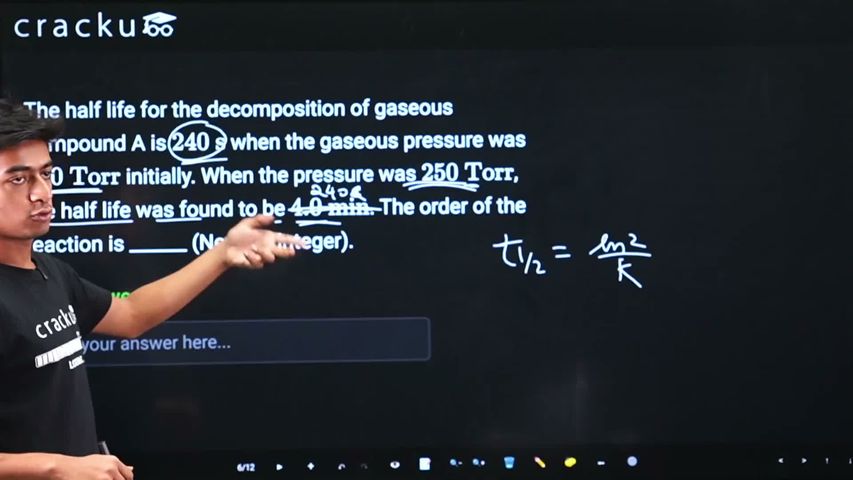
The half life for the decomposition of gaseous compound A is $$240 \text{ s}$$ when the gaseous pressure was $$500 \text{ Torr}$$ initially. When the pressure was $$250 \text{ Torr}$$, the half life was found to be $$4.0 \text{ min}$$. The order of the reaction is ______ (Nearest integer).
Correct Answer: 1
We need to determine the order of the decomposition reaction of compound A using the relationship between half-life and initial pressure.
For a reaction of order $$ n $$, the half-life is related to the initial concentration (or pressure) by:
$$t_{1/2} \propto P_0^{1-n}$$
This gives us:
$$\frac{t_{1/2,1}}{t_{1/2,2}} = \left(\frac{P_{0,1}}{P_{0,2}}\right)^{1-n}$$
First half-life: $$ t_{1/2,1} = 240 \text{ s} = 4 \text{ min} $$ at $$ P_{0,1} = 500 \text{ Torr} $$
Second half-life: $$ t_{1/2,2} = 4.0 \text{ min} = 240 \text{ s} $$ at $$ P_{0,2} = 250 \text{ Torr} $$
$$\frac{240}{240} = \left(\frac{500}{250}\right)^{1-n}$$
$$1 = 2^{1-n}$$
Since $$ 2^{1-n} = 1 = 2^0 $$, we get:
$$1 - n = 0$$
$$n = 1$$
The order of the reaction is 1.
Was this solution helpful?
Click on the Email ☝️ to Watch the Video Solution
Create a FREE account and get:
_1.webp)

Educational materials for JEE preparation

Ask our AI anything

AI can make mistakes. Please verify important information.
AI can make mistakes. Please verify important information.
