
Join Our JEE Preparation Group
Prep with like-minded aspirants; Get access to free daily tests and study material.
Sign in
Please select an account to continue using cracku.in
↓ →
Join Our JEE Preparation Group
Prep with like-minded aspirants; Get access to free daily tests and study material.
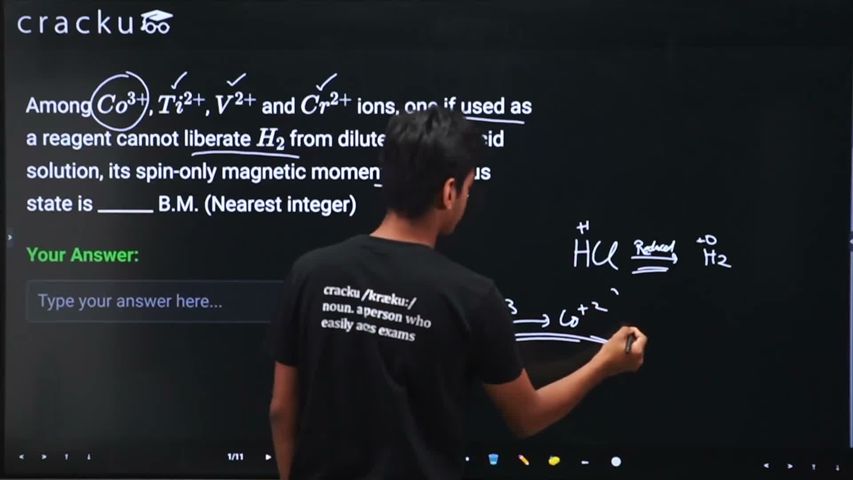
Among $$Co^{3+}$$, $$Ti^{2+}$$, $$V^{2+}$$ and $$Cr^{2+}$$ ions, one if used as a reagent cannot liberate $$H_2$$ from dilute mineral acid solution, its spin-only magnetic moment in gaseous state is ______ B.M. (Nearest integer)
Correct Answer: 5
We need to identify which ion among $$ Co^{3+} $$, $$ Ti^{2+} $$, $$ V^{2+} $$, and $$ Cr^{2+} $$ cannot liberate $$ H_2 $$ from dilute mineral acid, and then find its spin-only magnetic moment in the gaseous state.
To liberate $$ H_2 $$ from acid, the ion must be a reducing agent (must be oxidized). The standard reduction potentials are:
$$ Ti^{2+} $$, $$ V^{2+} $$, and $$ Cr^{2+} $$ are all good reducing agents that can reduce $$ H^+ $$ to $$ H_2 $$.
However, $$ Co^{3+} $$ is a strong oxidizing agent ($$ E^\circ_{Co^{3+}/Co^{2+}} = +1.82 \text{ V} $$). It will oxidize water rather than liberate $$ H_2 $$. Therefore, $$ Co^{3+} $$ cannot be used to liberate $$ H_2 $$ from dilute acid.
Cobalt (Co) has atomic number 27. Its electronic configuration is $$ [Ar] 3d^7 4s^2 $$.
For $$ Co^{3+} $$: remove 2 electrons from 4s and 1 from 3d, giving $$ [Ar] 3d^6 $$.
In the gaseous state (no ligand field), the $$ 3d^6 $$ configuration follows Hund's rule:
$$\uparrow\downarrow \quad \uparrow \quad \uparrow \quad \uparrow \quad \uparrow$$
This gives 4 unpaired electrons.
$$\mu = \sqrt{n(n+2)} = \sqrt{4(4+2)} = \sqrt{24} = 2\sqrt{6} \approx 4.9 \text{ B.M.}$$
Rounding to the nearest integer:
$$\mu \approx 5 \text{ B.M.}$$
The spin-only magnetic moment is 5 B.M.
Was this solution helpful?
Click on the Email ☝️ to Watch the Video Solution
Create a FREE account and get:
Educational materials for JEE preparation

Ask our AI anything

AI can make mistakes. Please verify important information.
AI can make mistakes. Please verify important information.

_1.webp)
