
Join Our JEE Preparation Group
Prep with like-minded aspirants; Get access to free daily tests and study material.
Sign in
Please select an account to continue using cracku.in
↓ →
Join Our JEE Preparation Group
Prep with like-minded aspirants; Get access to free daily tests and study material.
Number of complexes which show optical isomerism among the following is _________.
$$cis-[Cr(ox)_2Cl_2]^{3-}$$, $$[Co(en)_3]^{3+}$$, $$cis-[Pt(en)_2Cl_2]^{2+}$$, $$cis-[Co(en)_2Cl_2]^+$$, $$trans-[Pt(en)_2Cl_2]^{2+}$$, $$trans-[Cr(ox)_2Cl_2]^{3-}$$
Correct Answer: 4
We need to determine how many of the given complexes exhibit optical isomerism.
Key Concept: Optical isomers (enantiomers) are non-superimposable mirror images. A complex shows optical isomerism if it lacks an improper axis of symmetry (practically, if it has no plane of symmetry and no centre of symmetry). Generally, cis isomers of octahedral complexes with bidentate ligands are optically active, while trans isomers possess a plane of symmetry and are optically inactive.
Complex 1: $$cis\text{-}[Cr(ox)_2Cl_2]^{3-}$$
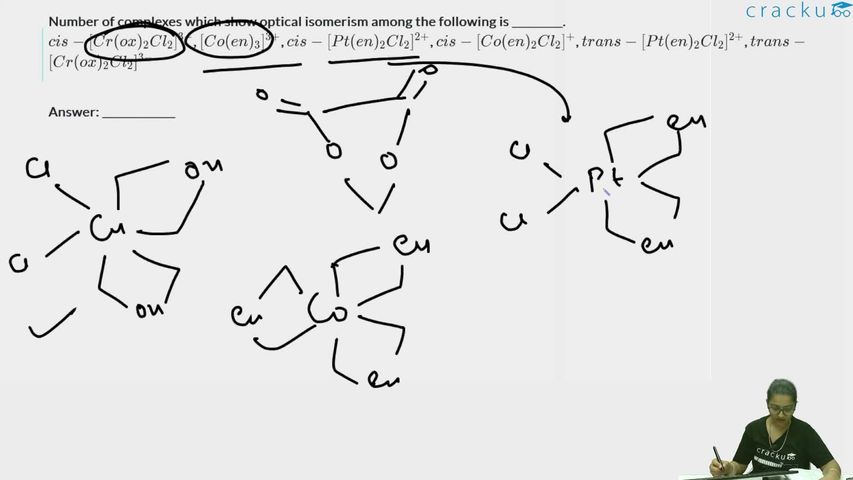
This is an octahedral complex with two bidentate oxalate (ox) ligands and two monodentate Cl ligands in the cis arrangement. The cis configuration lacks a plane of symmetry because the two Cl atoms are on the same side, and the bidentate oxalate ligands create an asymmetric arrangement. Its mirror image is non-superimposable.
Result: Optically active.
Complex 2: $$[Co(en)_3]^{3+}$$
This complex has three bidentate ethylenediamine (en) ligands arranged around Co$$^{3+}$$ in an octahedral geometry. With three identical bidentate ligands, the complex adopts a propeller-like arrangement. The mirror image ($$\Delta$$ and $$\Lambda$$ forms) are non-superimposable. This is a classic example of an optically active complex.
Result: Optically active.
Complex 3: $$cis\text{-}[Pt(en)_2Cl_2]^{2+}$$
This octahedral complex has two bidentate en ligands and two Cl ligands in cis positions. Similar to Complex 1, the cis arrangement with bidentate ligands creates an asymmetric structure with no plane of symmetry. The mirror image is non-superimposable.
Result: Optically active.
Complex 4: $$cis\text{-}[Co(en)_2Cl_2]^+$$
This octahedral complex has two bidentate en ligands and two Cl ligands in cis positions. The cis arrangement produces a structure without a plane of symmetry, and its mirror image is non-superimposable. This is another well-known example of an optically active coordination compound.
Result: Optically active.
Complex 5: $$trans\text{-}[Pt(en)_2Cl_2]^{2+}$$
In the trans arrangement, the two Cl ligands are on opposite sides (180 degrees apart). This trans configuration possesses a plane of symmetry that passes through the metal center and the two Cl atoms. The mirror image is superimposable on the original structure.
Result: NOT optically active.
Complex 6: $$trans\text{-}[Cr(ox)_2Cl_2]^{3-}$$
In the trans configuration, the two Cl ligands are positioned opposite to each other. This arrangement introduces a plane of symmetry in the complex, making the mirror image superimposable on the original.
Result: NOT optically active.
Counting: Complexes 1, 2, 3, and 4 are optically active. Complexes 5 and 6 are not.
The total number of complexes showing optical isomerism is $$\boxed{4}$$.
Was this solution helpful?
Click on the Email ☝️ to Watch the Video Solution
Create a FREE account and get:
_1.webp)

Educational materials for JEE preparation

Ask our AI anything

AI can make mistakes. Please verify important information.
AI can make mistakes. Please verify important information.
