
Join Our JEE Preparation Group
Prep with like-minded aspirants; Get access to free daily tests and study material.
Sign in
Please select an account to continue using cracku.in
↓ →
Join Our JEE Preparation Group
Prep with like-minded aspirants; Get access to free daily tests and study material.
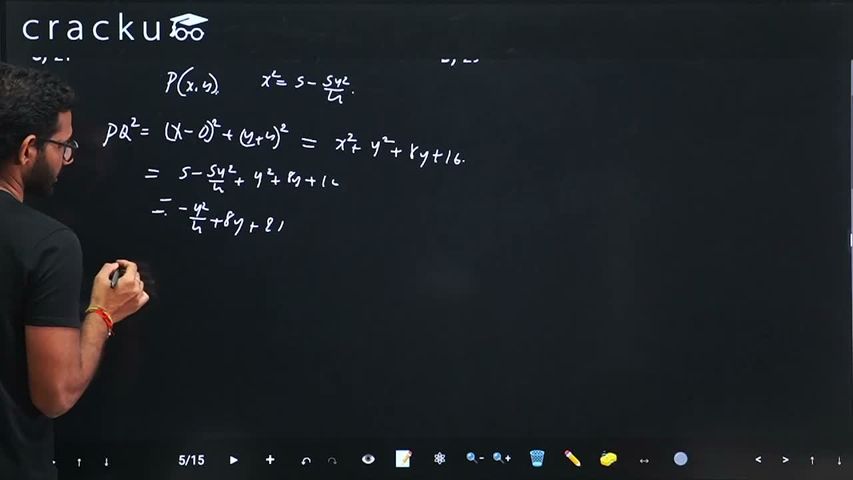
If the point $$P$$ on the curve, $$4x^2 + 5y^2 = 20$$ is farthest from the point $$Q(0, -4)$$, then $$PQ^2$$ is equal to:
We have to find the point $$P(x,\,y)$$ lying on the curve $$4x^2 + 5y^2 = 20$$ that is farthest from the fixed point $$Q(0,\,-4)$$. Instead of the distance itself, we maximise the square of the distance, because the square reaches its maximum at the same point and is easier to handle algebraically.
Let us denote the square of the distance by
$$D^2 \;=\; (x-0)^2 \;+\; (y+4)^2 \;=\; x^2 + (y+4)^2.$$
The point $$P(x,\,y)$$ must satisfy the given constraint
$$4x^2 + 5y^2 = 20.$$
To maximise $$D^2$$ under this constraint we use the method of Lagrange multipliers. We set up
$$f(x,y) = x^2 + (y+4)^2,$$
and introduce the function
$$g(x,y) = 4x^2 + 5y^2 - 20 = 0.$$
The gradient equations are
$$\nabla f \;=\; \lambda \,\nabla g.$$
First compute the partial derivatives:
$$\frac{\partial f}{\partial x} = 2x, \qquad \frac{\partial f}{\partial y} = 2(y+4),$$
$$\frac{\partial g}{\partial x} = 8x, \qquad \frac{\partial g}{\partial y} = 10y.$$
Equating corresponding components, we obtain two equations:
$$2x = \lambda\,(8x) \quad\Longrightarrow\quad 2x = 8\lambda x,$$
$$2(y+4) = \lambda\,(10y) \quad\Longrightarrow\quad 2(y+4) = 10\lambda y.$$
From the first equation, two possibilities arise:
(i) $$x = 0,$$ (ii) $$x \neq 0,$$ in which case we may cancel $$x$$ and get $$\lambda = \dfrac14.$$
Case (i) $$x = 0$$.
Substituting into the constraint,
$$4(0)^2 + 5y^2 = 20 \;\Longrightarrow\; 5y^2 = 20 \;\Longrightarrow\; y^2 = 4 \;\Longrightarrow\; y = \pm 2.$$
Now compute the squared distances:
For $$y = 2\!:$$
$$D^2 = 0^2 + (2+4)^2 = 6^2 = 36.$$
For $$y = -2\!:$$
$$D^2 = 0^2 + (-2+4)^2 = 2^2 = 4.$$
Case (ii) $$x \neq 0,\;\lambda = \dfrac14$$.
Insert $$\lambda = \dfrac14$$ into the second Lagrange equation:
$$2(y+4) = 10\Bigl(\dfrac14\Bigr) y = \dfrac{10y}{4} = \dfrac{5y}{2}.$$
Multiply both sides by 2:
$$4(y+4) = 5y \;\Longrightarrow\; 4y + 16 = 5y \;\Longrightarrow\; 16 = y.$$
Now use the constraint:
$$4x^2 + 5(16)^2 = 20 \;\Longrightarrow\; 4x^2 + 5\cdot256 = 20 \;\Longrightarrow\; 4x^2 + 1280 = 20 \;\Longrightarrow\; 4x^2 = -1260,$$
which is impossible for real $$x$$. Hence no admissible point arises from this case.
Therefore the only valid candidates are the two points with $$x = 0$$ and $$y = \pm 2$$, among which the farthest one is $$P(0,\,2)$$ giving
$$PQ^2 = 36.$$
Hence, the correct answer is Option A.
Was this solution helpful?
Click on the Email ☝️ to Watch the Video Solution
Create a FREE account and get:
_1.webp)

Educational materials for JEE preparation

Ask our AI anything

AI can make mistakes. Please verify important information.
AI can make mistakes. Please verify important information.


