
Join Our JEE Preparation Group
Prep with like-minded aspirants; Get access to free daily tests and study material.
Sign in
Please select an account to continue using cracku.in
↓ →
Join Our JEE Preparation Group
Prep with like-minded aspirants; Get access to free daily tests and study material.
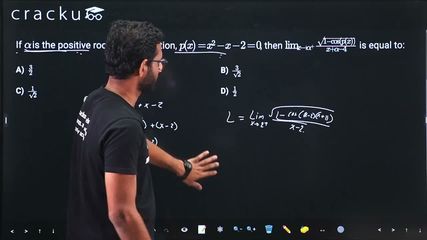
If $$\alpha$$ is the positive root of the equation, $$p(x) = x^2 - x - 2 = 0$$, then $$\lim_{x \to \alpha^+} \frac{\sqrt{1 - \cos(p(x))}}{x + \alpha - 4}$$ is equal to:
First, we observe the quadratic equation $$p(x)=x^2-x-2=0$$ whose positive root has been denoted by $$\alpha$$. To find this root we apply the quadratic‐formula
$$x=\frac{-b\pm\sqrt{b^2-4ac}}{2a}$$
with $$a=1,\; b=-1,\; c=-2$$. Substituting, we get
$$x=\frac{-(-1)\pm\sqrt{(-1)^2-4(1)(-2)}}{2(1)} =\frac{1\pm\sqrt{1+8}}{2} =\frac{1\pm3}{2}.$$
The two values are $$\frac{1+3}{2}=2$$ and $$\frac{1-3}{2}=-1$$. Since we need the positive root, we take
$$\alpha=2.$$
The limit to be evaluated is
$$L=\lim_{x\to\alpha^{+}}\frac{\sqrt{1-\cos\!\bigl(p(x)\bigr)}}{x+\alpha-4}.$$
Because $$\alpha=2$$, the denominator simplifies neatly:
$$x+\alpha-4=x+2-4=x-2.$$
Hence
$$L=\lim_{x\to2^{+}}\frac{\sqrt{1-\cos\!\bigl(p(x)\bigr)}}{x-2}.$$
Now we rewrite $$p(x)$$ in a factorised form to understand its behaviour near $$x=2$$:
$$p(x)=x^2-x-2 =x^2-x-2+2-2 =(x^2-4)+(-x+2) =(x-2)(x+2)-1(x-2) =(x-2)(x+2-1) =(x-2)(x+1).$$
So, very compactly,
$$p(x)=(x-2)(x+1).$$
Notice that $$p(2)=0$$, and for $$x>2$$ we have $$x-2>0$$ and $$x+1>0$$, giving $$p(x)>0$$ just to the right of $$x=2$$. Therefore $$p(x)$$ itself (not its absolute value) will be small and positive as $$x\to2^{+}$$.
Whenever an angle $$\theta$$ approaches $$0$$, we use the standard trigonometric approximation
$$1-\cos\theta\;\approx\;\frac{\theta^{2}}{2}\quad\text{as}\quad\theta\to0.$$
Here our “angle” is $$\theta=p(x)$$, which indeed tends to $$0$$ when $$x\to2^{+}$$. Applying the approximation gives
$$1-\cos\!\bigl(p(x)\bigr)\;\approx\;\frac{p(x)^2}{2}.$$
Taking square roots on both sides, we obtain
$$\sqrt{1-\cos\!\bigl(p(x)\bigr)}\;\approx\;\sqrt{\frac{p(x)^2}{2}} =\frac{|p(x)|}{\sqrt{2}}.$$
But, as discussed, $$p(x)>0$$ when $$x>2$$, so $$|p(x)|=p(x)$$. Thus for $$x$$ close to but greater than $$2$$ we may replace the numerator by $$\dfrac{p(x)}{\sqrt{2}}$$, giving
$$\frac{\sqrt{1-\cos\!\bigl(p(x)\bigr)}}{x-2}\;\approx\;\frac{\dfrac{p(x)}{\sqrt{2}}}{x-2} =\frac{p(x)}{\sqrt{2}\,(x-2)}.$$
Hence our limit becomes
$$L=\lim_{x\to2^{+}}\frac{p(x)}{\sqrt{2}\,(x-2)}.$$
We have already factored $$p(x)$$, so we can simplify the fraction algebraically before taking the limit:
$$\frac{p(x)}{x-2} =\frac{(x-2)(x+1)}{x-2} =x+1,\qquad x\neq2.$$
Therefore
$$L=\lim_{x\to2^{+}}\frac{x+1}{\sqrt{2}} =\frac{\;\lim_{x\to2^{+}}(x+1)}{\sqrt{2}} =\frac{2+1}{\sqrt{2}} =\frac{3}{\sqrt{2}}.$$
Hence, the correct answer is Option B.
Was this solution helpful?
Click on the Email ☝️ to Watch the Video Solution
Create a FREE account and get:
_1.webp)

Educational materials for JEE preparation

Ask our AI anything

AI can make mistakes. Please verify important information.
AI can make mistakes. Please verify important information.


