
Join Our JEE Preparation Group
Prep with like-minded aspirants; Get access to free daily tests and study material.
Sign in
Please select an account to continue using cracku.in
↓ →
Join Our JEE Preparation Group
Prep with like-minded aspirants; Get access to free daily tests and study material.
If the co-ordinates of two points $$A$$ and $$B$$ are $$\left(\sqrt{7}, 0\right)$$ and $$\left(-\sqrt{7}, 0\right)$$ respectively and $$P$$ is any point on the conic, $$9x^2 + 16y^2 = 144$$, then $$PA + PB$$ is equal to:
We are given that point $$P(x,y)$$ lies on the conic $$9x^2 + 16y^2 = 144$$.
First we rewrite the conic in standard ellipse form. Dividing every term by $$144$$, we obtain
$$\dfrac{9x^2}{144} + \dfrac{16y^2}{144} = 1.$$
Simplifying the fractions,
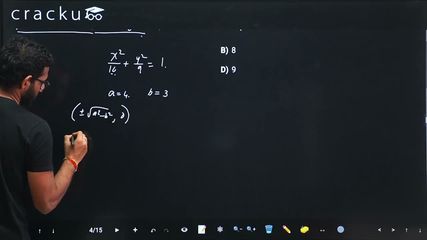
$$\dfrac{x^2}{16} + \dfrac{y^2}{9} = 1.$$
We recognise $$\dfrac{x^2}{a^2} + \dfrac{y^2}{b^2} = 1$$ as the standard equation of an ellipse centred at the origin with semi-major axis $$a$$ and semi-minor axis $$b$$. Comparing, we have
$$a^2 = 16 \quad\Rightarrow\quad a = 4, \qquad b^2 = 9 \quad\Rightarrow\quad b = 3.$$
For any ellipse, the distance from the centre to each focus (denoted $$c$$) satisfies the relation
$$c^2 = a^2 - b^2.$$
Substituting our values $$a^2 = 16$$ and $$b^2 = 9$$, we get
$$c^2 = 16 - 9 = 7 \;\;\Longrightarrow\;\; c = \sqrt{7}.$$
Hence the foci are located at $$(c,0)$$ and $$(-c,0),$$ namely $$(\sqrt{7},0)$$ and $$(-\sqrt{7},0).$$ These are exactly the points $$A$$ and $$B$$ given in the question.
Now we recall the fundamental property of an ellipse:
The sum of the distances from any point on an ellipse to its two foci is constant and equals $$2a$$.
Here, $$a = 4,$$ so
$$PA + PB = 2a = 2 \times 4 = 8.$$
Therefore the value of $$PA + PB$$ is a constant $$8$$ for every point $$P$$ on the given ellipse.
Hence, the correct answer is Option B.
Was this solution helpful?
Click on the Email ☝️ to Watch the Video Solution
Create a FREE account and get:
_1.webp)

Educational materials for JEE preparation

Ask our AI anything

AI can make mistakes. Please verify important information.
AI can make mistakes. Please verify important information.


