
Join Our JEE Preparation Group
Prep with like-minded aspirants; Get access to free daily tests and study material.
Sign in
Please select an account to continue using cracku.in
↓ →
Join Our JEE Preparation Group
Prep with like-minded aspirants; Get access to free daily tests and study material.
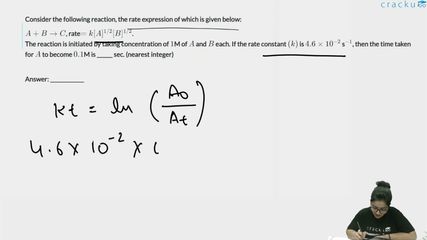
Consider the following reaction, the rate expression of which is given below:
$$A + B \rightarrow C$$, rate$$ = k[A]^{1/2}[B]^{1/2}$$.
The reaction is initiated by taking concentration of $$1$$M of $$A$$ and $$B$$ each. If the rate constant $$(k)$$ is $$4.6 \times 10^{-2}$$ s$$^{-1}$$, then the time taken for $$A$$ to become $$0.1$$M is ______ sec. (nearest integer)
Correct Answer: 50
We seek the time required for [A] to drop from 1 M to 0.1 M under the rate law $$k[A]^{1/2}[B]^{1/2}$$, with $$[A]_0 = [B]_0 = 1$$ M and $$k = 4.6 \times 10^{-2}$$ s$$^{-1}$$.
Since $$[A]_0 = [B]_0$$ and they appear symmetrically in the rate expression, [A] remains equal to [B] at all times, which gives $$rate = k[A]^{1/2}[A]^{1/2} = k[A].$$ This effective rate law is thus first order in [A].
Using the first-order integrated rate law, we write $$\ln\frac{[A]_0}{[A]} = kt.$$ Substituting the values yields $$\ln\frac{1}{0.1} = 4.6 \times 10^{-2} \times t,$$ so $$\ln 10 = 4.6 \times 10^{-2} \times t.$$
Since $$\ln 10 = 2.303,$$ it follows that $$2.303 = 4.6 \times 10^{-2} \times t,$$ and hence $$t = \frac{2.303}{0.046} = 50.07 \approx 50 \text{ sec}.$$
The correct answer is 50.
Was this solution helpful?
Click on the Email ☝️ to Watch the Video Solution
Create a FREE account and get:
_1.webp)

Educational materials for JEE preparation

Ask our AI anything

AI can make mistakes. Please verify important information.
AI can make mistakes. Please verify important information.
