
Join Our JEE Preparation Group
Prep with like-minded aspirants; Get access to free daily tests and study material.
Sign in
Please select an account to continue using cracku.in
↓ →
Join Our JEE Preparation Group
Prep with like-minded aspirants; Get access to free daily tests and study material.
Arrange the following resultant mixtures in increasing order of their pH values
A. 10 mL 0.2 M Ca(OH)$$_2$$ + 25 mL 0.1 M HCl
B. 10 mL 0.01 M H$$_2$$SO$$_4$$ + 10 mL 0.01 M Ca(OH)$$_2$$
C. 10 mL 0.1 M H$$_2$$SO$$_4$$ + 10 mL 0.1 M KOH
Choose the correct answer from the options given below:
By Comparing excess $$H^+$$ and $$OH^-$$ in each mixture we can determine whether the solution is Acidic, Basic, or Neutral.
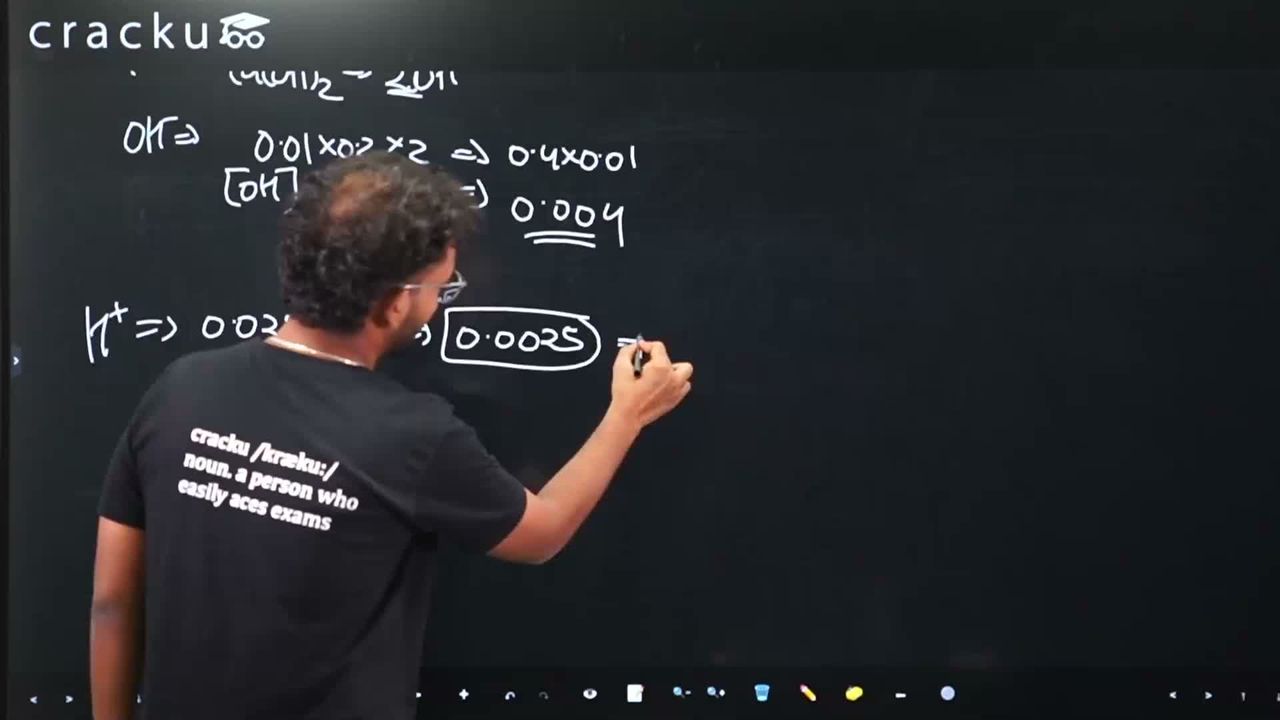
$$A.\ 10ml\ 0.2M\ Ca\left(OH\right)_2\ +\ 25ml\ 0.1M\ HCl$$
$$Ca\left(OH\right)_2\longrightarrow\ 2OH^-$$
Moles of $$OH^-$$:
$$0.2\times\ 0.01\times\ 2=0.004$$
Moles of $$H^+$$:
$$0.1\times\ 0.025=0.0025$$
Excess $$OH^-$$:
$$0.004-0.0025=0.0015$$
Solution is Basic.
$$B.\ 10\ ml\ 0.01\ M\ H_2SO_4+10\ ml\ 0.01M\ Ca\left(OH\right)_2$$
For $$H_2SO_4:$$
$$H_2SO_4\longrightarrow\ 2H^+$$
Moles of $$H^+$$:
$$0.01\times\ 0.01\times\ 2=2\times\ 10^{-4}$$
Moles of $$OH^-$$:
$$0.01\times\ 0.01\times\ 2=2\times\ 10^{-4}$$
Exactly Neutral
$$pH\approx\ 7$$
$$C.\ 10mL\ 0.1\ M\ H_2SO_4+10\ mL\ 0.1\ M\ KOH$$
Moles of $$H^+$$:
$$0.1\times\ 0.01\times\ 2=0.002$$
Moles of $$OH^-$$:
$$0.1\times\ 0.01=0.001$$
Solution is acidic.
Therefore,
C$$\longrightarrow\ $$ acidic(lowest pH)
B$$\longrightarrow\ $$ neutral
A$$\longrightarrow\ $$ basic (highest pH)
Therefore, the order will be $$C<B<A$$
i.e Option C
Was this solution helpful?
Click on the Email ☝️ to Watch the Video Solution
Create a FREE account and get:
_1.webp)

Educational materials for JEE preparation

Ask our AI anything

AI can make mistakes. Please verify important information.
AI can make mistakes. Please verify important information.


