Join Our JEE Preparation Group
Prep with like-minded aspirants; Get access to free daily tests and study material.
Sign in
Please select an account to continue using cracku.in
↓ →
Join Our JEE Preparation Group
Prep with like-minded aspirants; Get access to free daily tests and study material.
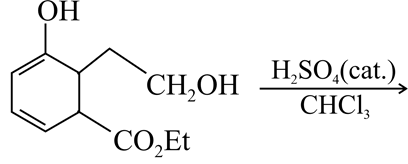
The starting material contains a cyclohexadiene ring with an enol group, an aliphatic alcohol side chain (-CH2CH2OH), and an ester group (-CO2Et).
When treated with a catalytic amount of strong acid (H2SO4) in chloroform (CHCl3), the driving force of the reaction is aromatization via a dehydration/elimination mechanism.
The enol moiety on the diene ring readily protonates under acidic conditions. However, a more thermodynamically favorable pathway involves the dehydration of the adjacent aliphatic alcohol to form a stable tricyclic/aromatic framework, or more directly, the elimination of water from the ring itself to establish complete aromaticity.
Let's look at the ring structure: it is a cyclohexa-1,3-diene derivative with an -OH group on one of the sp2 carbons (an enol).
Once the ring becomes a phenol/benzene derivative, the primary alcohol group (-CH2CH2OH) and the ester group (-CO2Et) are perfectly positioned on adjacent positions (ortho to each other) of the newly formed aromatic ring.
The final product consists of a fused bicyclic system where a benzene ring is fused to a lactone ring, with a phenolic -OH group on the aromatic ring.
4-hydroxy-1,3-dihydro-2-benzofuran-1-one (commonly known as a phthalide derivative with a phenolic -OH group).
Was this solution helpful?
Create a FREE account and get:
_1.webp)

Educational materials for JEE preparation

Ask our AI anything

AI can make mistakes. Please verify important information.
AI can make mistakes. Please verify important information.