
Join Our JEE Preparation Group
Prep with like-minded aspirants; Get access to free daily tests and study material.
Sign in
Please select an account to continue using cracku.in
↓ →
Join Our JEE Preparation Group
Prep with like-minded aspirants; Get access to free daily tests and study material.
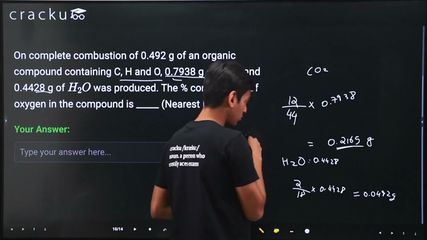
On complete combustion of 0.492 g of an organic compound containing C, H and O, 0.7938 g of $$CO_2$$ and 0.4428 g of $$H_2O$$ was produced. The % composition of oxygen in the compound is _____ (Nearest Integer)
Correct Answer: 46
The mass of the organic compound was 0.492 g and it contains C, H, and O. When combusted, it produced 0.7938 g of $$CO_2$$ and 0.4428 g of $$H_2O$$.
Since each mole of $$CO_2$$ (44 g) contains 1 mole of C (12 g), we calculate the mass of carbon as follows:
$$\text{Mass of C} = \frac{12}{44} \times 0.7938 = \frac{12 \times 0.7938}{44} = \frac{9.5256}{44} = 0.2163 \text{ g}$$
Similarly, every mole of $$H_2O$$ (18 g) contains 2 moles of H (2 g), so the mass of hydrogen is given by:
$$\text{Mass of H} = \frac{2}{18} \times 0.4428 = \frac{0.8856}{18} = 0.0492 \text{ g}$$
From the above masses, we find the mass of oxygen in the compound by subtracting the masses of C and H from the total mass:
$$\text{Mass of O} = 0.492 - 0.2163 - 0.0492 = 0.2265 \text{ g}$$
This gives the percentage of oxygen as:
$$\% \text{ of O} = \frac{0.2265}{0.492} \times 100 = 46.04\%$$
Therefore, the percentage composition of oxygen in the compound is 46% (nearest integer).
Click on the Email ☝️ to Watch the Video Solution
Create a FREE account and get:
_1.webp)

Educational materials for JEE preparation

Ask our AI anything

AI can make mistakes. Please verify important information.
AI can make mistakes. Please verify important information.


