
Join Our JEE Preparation Group
Prep with like-minded aspirants; Get access to free daily tests and study material.
Sign in
Please select an account to continue using cracku.in
↓ →
Join Our JEE Preparation Group
Prep with like-minded aspirants; Get access to free daily tests and study material.
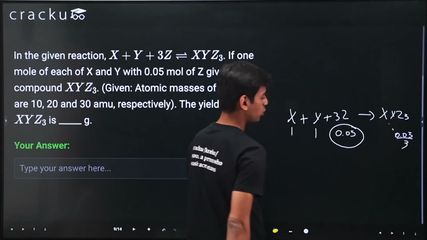
In the given reaction, $$X + Y + 3Z \rightleftharpoons XYZ_3$$. If one mole of each of X and Y with 0.05 mol of Z gives compound $$XYZ_3$$. (Given: Atomic masses of X, Y and Z are 10, 20 and 30 amu, respectively). The yield of $$XYZ_3$$ is _____ g.
Correct Answer: 2
The reaction is given by $$X + Y + 3Z \rightleftharpoons XYZ_3$$ and the initial amounts are 1 mol of X, 1 mol of Y, and 0.05 mol of Z, while the atomic masses are 10 amu for X, 20 amu for Y, and 30 amu for Z.
Since the reaction requires X, Y, and Z in the molar ratio 1 : 1 : 3 and only 0.05 mol of Z is available, the maximum moles of $$XYZ_3$$ that can be formed is $$\frac{0.05}{3}$$ mol, indicating that Z is the limiting reagent.
Substituting the atomic masses into the molar mass formula gives $$M_{XYZ_3} = 10 + 20 + 3 \times 30 = 10 + 20 + 90 = 120 \text{ g/mol}$$.
From the moles of product and its molar mass, the mass formed is $$\text{Mass} = \frac{0.05}{3} \times 120 = \frac{6}{3} = 2 \text{ g}$$.
Therefore, the yield of $$XYZ_3$$ is 2 g.
Click on the Email ☝️ to Watch the Video Solution
Create a FREE account and get:
_1.webp)

Educational materials for JEE preparation

Ask our AI anything

AI can make mistakes. Please verify important information.
AI can make mistakes. Please verify important information.


