
Join Our JEE Preparation Group
Prep with like-minded aspirants; Get access to free daily tests and study material.
Sign in
Please select an account to continue using cracku.in
↓ →
Join Our JEE Preparation Group
Prep with like-minded aspirants; Get access to free daily tests and study material.
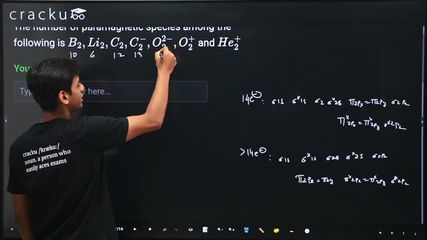
The number of paramagnetic species among the following is $$B_2, Li_2, C_2, C_2^-, O_2^{2-}, O_2^+$$ and $$He_2^+$$
Correct Answer: 4
A paramagnetic species has one or more unpaired electrons. We use Molecular Orbital Theory (MOT) to determine the electronic configuration and count unpaired electrons for each species.
Key MOT orbital filling order:
For $$B_2$$, $$C_2$$, $$N_2$$ (up to 14 electrons): $$\sigma_{1s} \lt \sigma^*_{1s} \lt \sigma_{2s} \lt \sigma^*_{2s} \lt \pi_{2p_x} = \pi_{2p_y} \lt \sigma_{2p_z} \lt \pi^*_{2p_x} = \pi^*_{2p_y} \lt \sigma^*_{2p_z}$$
For $$O_2$$ and heavier (15+ electrons): $$\sigma_{1s} \lt \sigma^*_{1s} \lt \sigma_{2s} \lt \sigma^*_{2s} \lt \sigma_{2p_z} \lt \pi_{2p_x} = \pi_{2p_y} \lt \pi^*_{2p_x} = \pi^*_{2p_y} \lt \sigma^*_{2p_z}$$
1. $$B_2$$ (total electrons = 5 + 5 = 10):
Configuration: $$\sigma_{1s}^2\, {\sigma^*_{1s}}^{2}\, \sigma_{2s}^2\, {\sigma^*_{2s}}^{2}\, \pi_{2p_x}^1\, \pi_{2p_y}^1$$
The last two electrons enter the two degenerate $$\pi_{2p}$$ orbitals with parallel spins (Hund's rule), giving 2 unpaired electrons.
Bond order = $$\f\frac{6-4}{2} = 1$$. Paramagnetic.
2. $$Li_2$$ (total electrons = 3 + 3 = 6):
Configuration: $$\sigma_{1s}^2\, {\sigma^*_{1s}}^{2}\, \sigma_{2s}^2$$
All electrons are paired. 0 unpaired electrons.
Bond order = $$\f\frac{4-2}{2} = 1$$. Diamagnetic.
3. $$C_2$$ (total electrons = 6 + 6 = 12):
Configuration: $$\sigma_{1s}^2\, {\sigma^*_{1s}}^{2}\, \sigma_{2s}^2\, {\sigma^*_{2s}}^{2}\, \pi_{2p_x}^2\, \pi_{2p_y}^2$$
Both $$\pi_{2p}$$ orbitals are completely filled. 0 unpaired electrons.
Bond order = $$\f\frac{8-4}{2} = 2$$. Diamagnetic.
4. $$C_2^-$$ (total electrons = 12 + 1 = 13):
Configuration: $$\sigma_{1s}^2\, {\sigma^*_{1s}}^{2}\, \sigma_{2s}^2\, {\sigma^*_{2s}}^{2}\, \pi_{2p_x}^2\, \pi_{2p_y}^2\, \sigma_{2p_z}^1$$
The 13th electron enters the $$\sigma_{2p_z}$$ orbital (which comes after $$\pi_{2p}$$ in the filling order for lighter elements). This gives 1 unpaired electron.
Bond order = $$\f\frac{9-4}{2} = 2.5$$. Paramagnetic.
5. $$O_2^{2-}$$ (total electrons = 16 + 2 = 18):
Configuration (using O-type ordering): $$\sigma_{1s}^2\, {\sigma^*_{1s}}^{2}\, \sigma_{2s}^2\, {\sigma^*_{2s}}^{2}\, \sigma_{2p_z}^2\, \pi_{2p_x}^2\, \pi_{2p_y}^2\, {\pi^*_{2p_x}}^{2}\, {\pi^*_{2p_y}}^{2}$$
Both antibonding $$\pi^*$$ orbitals are completely filled. 0 unpaired electrons.
Bond order = $$\f\frac{10-8}{2} = 1$$. Diamagnetic.
6. $$O_2^+$$ (total electrons = 16 - 1 = 15):
Configuration: $$\sigma_{1s}^2\, {\sigma^*_{1s}}^{2}\, \sigma_{2s}^2\, {\sigma^*_{2s}}^{2}\, \sigma_{2p_z}^2\, \pi_{2p_x}^2\, \pi_{2p_y}^2\, {\pi^*_{2p_x}}^{1}$$
One electron is removed from the antibonding $$\pi^*$$ orbital, leaving 1 unpaired electron.
Bond order = $$\f\frac{10-5}{2} = 2.5$$. Paramagnetic.
7. $$He_2^+$$ (total electrons = 2 + 2 - 1 = 3):
Configuration: $$\sigma_{1s}^2\, {\sigma^*_{1s}}^{1}$$
The antibonding orbital has one electron. 1 unpaired electron.
Bond order = $$\f\frac{2-1}{2} = 0.5$$. Paramagnetic.
Summary:
| Species | Total $$e^-$$ | Unpaired $$e^-$$ | Nature |
|---|---|---|---|
| $$B_2$$ | 10 | 2 | Paramagnetic |
| $$Li_2$$ | 6 | 0 | Diamagnetic |
| $$C_2$$ | 12 | 0 | Diamagnetic |
| $$C_2^-$$ | 13 | 1 | Paramagnetic |
| $$O_2^{2-}$$ | 18 | 0 | Diamagnetic |
| $$O_2^+$$ | 15 | 1 | Paramagnetic |
| $$He_2^+$$ | 3 | 1 | Paramagnetic |
The paramagnetic species are: $$B_2$$, $$C_2^-$$, $$O_2^+$$, and $$He_2^+$$.
Therefore, the number of paramagnetic species is 4.
Click on the Email ☝️ to Watch the Video Solution
Create a FREE account and get:
_1.webp)

Educational materials for JEE preparation

Ask our AI anything

AI can make mistakes. Please verify important information.
AI can make mistakes. Please verify important information.


