
Join Our JEE Preparation Group
Prep with like-minded aspirants; Get access to free daily tests and study material.
Sign in
Please select an account to continue using cracku.in
↓ →
Join Our JEE Preparation Group
Prep with like-minded aspirants; Get access to free daily tests and study material.
XY is the membrane/partition between two chambers 1 and 2 containing sugar solutions of concentration $$c_1$$ and $$c_2$$ ($$c_1 \gt c_2$$) mol $$L^{-1}$$. For the reverse osmosis to take place identify the correct condition. (Here $$p_1$$ and $$p_2$$ are pressures applied on chamber 1 and 2)
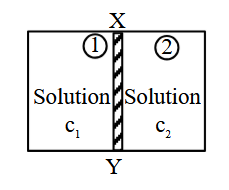
(A) Membrane/Partition ; Cellophane, $$p_{1} > \pi$$
(B) Membrane/Partition ; Porous.$$p_{2} > \pi$$
(C) Membrane/Partition ; Parchment paper, $$p_{1} > \pi$$
(D) Membrane/Partition : Cellophane, $$p_{2} > \pi$$
Choose the correct answer from the options given below :
To identify the correct conditions for reverse osmosis in this setup, we must understand the principles of osmosis, applied pressure, and membrane permeability.
The concentration of the solution in Chamber 1 is greater than that in Chamber 2, i.e.,
$$c_1 > c_2.$$
Under natural osmotic conditions, the solvent flows from the region of lower solute concentration (Chamber 2) to the region of higher solute concentration (Chamber 1) through a semipermeable membrane. The osmotic pressure $$\pi$$ is the minimum pressure that must be applied to the concentrated solution to stop this natural flow of solvent.
In reverse osmosis, the solvent is forced to move in the opposite direction, from the concentrated solution to the dilute solution. To achieve this, pressure must be applied on the concentrated side (Chamber 1), and the applied pressure must be greater than the osmotic pressure. Hence, the required condition is
$$p_1 > \pi.$$
The membrane separating the two chambers must also be a semipermeable membrane (SPM), which allows only solvent molecules to pass through while preventing the passage of solute particles. Cellophane and parchment paper act as semipermeable membranes, whereas an ordinary porous partition allows both solute and solvent to pass through and therefore cannot produce reverse osmosis.
Evaluating the given statements:
Therefore, the correct statements are A and C only.
Hence, the correct answer is
$$\boxed{\text{A and C only}}.$$
Was this solution helpful?
Create a FREE account and get:
_1.webp)

Educational materials for JEE preparation

Ask our AI anything

AI can make mistakes. Please verify important information.
AI can make mistakes. Please verify important information.
