
Join Our JEE Preparation Group
Prep with like-minded aspirants; Get access to free daily tests and study material.
Sign in
Please select an account to continue using cracku.in
↓ →
Join Our JEE Preparation Group
Prep with like-minded aspirants; Get access to free daily tests and study material.
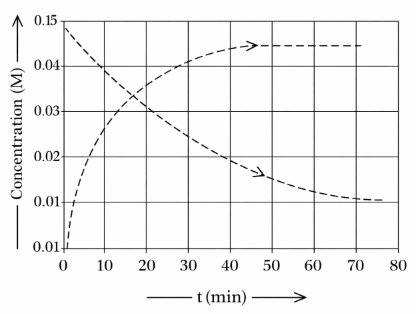
Given above is the concentration vs time plot for a dissociation reaction : $$A \rightarrow nB$$ .
Based on the data of the initial phase of the reaction (initial 10 min), the value of n is________.
Let the stoichiometry of the dissociation be $$A \rightarrow nB$$.
For any reaction written as $$aA \rightarrow bB$$, the rate at any instant is defined so that the expressions for all species are equal in magnitude:
$$\text{rate} = -\dfrac{1}{a}\dfrac{d[A]}{dt} = \dfrac{1}{b}\dfrac{d[B]}{dt}$$
In our case $$a = 1$$ and $$b = n$$, giving
$$-\dfrac{d[A]}{dt} = \dfrac{1}{n}\dfrac{d[B]}{dt}\qquad -(1)$$
The concentration-time plot supplied in the question shows the behaviour during the first 10 min:
• [A] falls from 1.00 M to 0.90 M (a decrease of 0.10 M).
• [B] rises from 0 to 0.30 M (an increase of 0.30 M).
Using the magnitudes of the initial slopes, equation $$(1)$$ becomes
$$0.10 = \dfrac{1}{n}\,(0.30)$$
Solving for $$n$$,
$$n = \dfrac{0.30}{0.10} = 3$$
Hence, the dissociation reaction produces three moles of B for every mole of A that disappears.
Option D which is: 3
Was this solution helpful?
Create a FREE account and get:
_1.webp)

Educational materials for JEE preparation

Ask our AI anything

AI can make mistakes. Please verify important information.
AI can make mistakes. Please verify important information.
