
Join Our JEE Preparation Group
Prep with like-minded aspirants; Get access to free daily tests and study material.
Sign in
Please select an account to continue using cracku.in
↓ →
Join Our JEE Preparation Group
Prep with like-minded aspirants; Get access to free daily tests and study material.
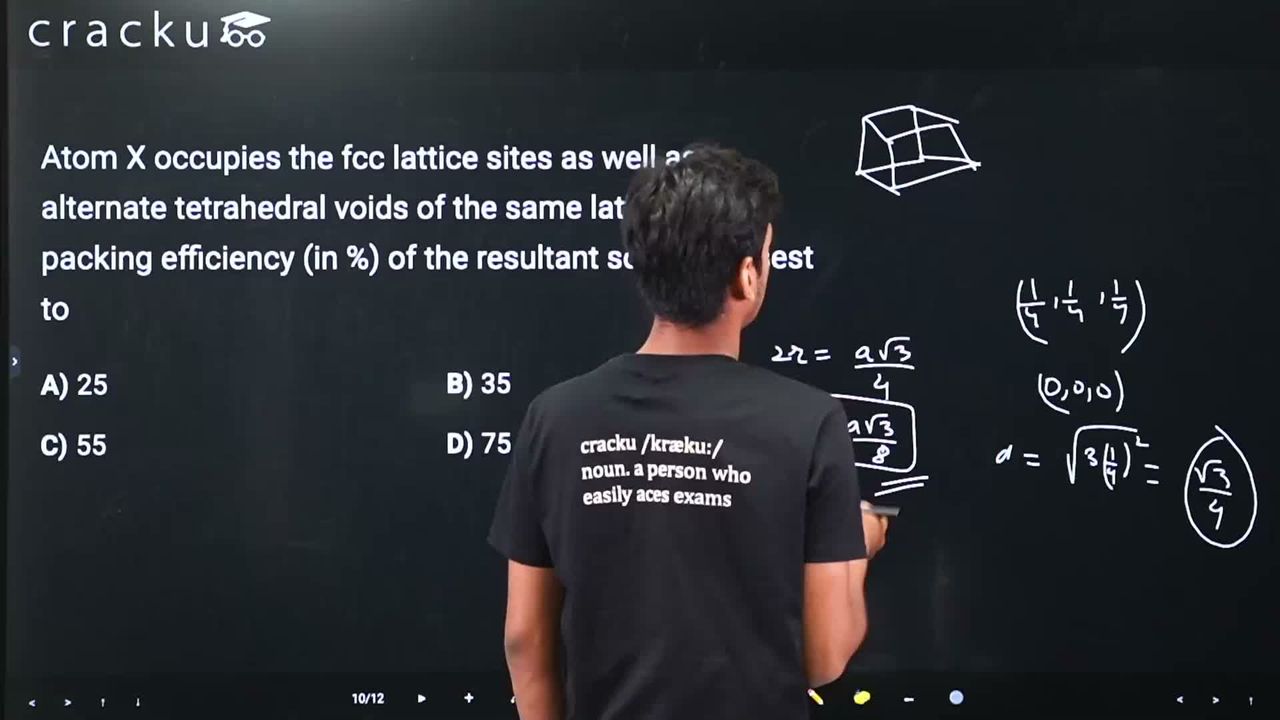
Atom X occupies the fcc lattice sites as well as alternate tetrahedral voids of the same lattice. The packing efficiency (in %) of the resultant solid is closest to
Let the edge length of the fcc unit cell be $$a$$ and the radius of every atom (both on lattice points and in the voids) be $$r$$.
Step 1 - Find the shortest centre-to-centre distance.
In an fcc lattice a tetrahedral void is situated, for example, at $$\left(\tfrac14,\tfrac14,\tfrac14\right)$$ while the nearest lattice atom is at the corner $$\left(0,0,0\right)$$. Their separation is
$$d_{\text{tv-fcc}} = a\sqrt{\left(\tfrac14\right)^2+\left(\tfrac14\right)^2+\left(\tfrac14\right)^2}
= a\frac{\sqrt3}{4} \;$$
The next smaller distance is between two lattice atoms (corner to face-centre): $$d_{\text{fcc-fcc}} = \frac{a}{\sqrt2}$$ Since $$\dfrac{a}{\sqrt2}\gt\dfrac{a\sqrt3}{4}$$, the shortest distance in the occupied arrangement is $$d_{\text{tv-fcc}} = a\sqrt3/4$$.
Step 2 - Relate $$r$$ to $$a$$.
For closest packing we let the atoms in a tetrahedral void just touch the nearest lattice atom:
$$2r = \frac{a\sqrt3}{4}\;\Rightarrow\; r = \frac{a\sqrt3}{8}$$
Step 3 - Count the number of atoms per unit cell.
• fcc lattice sites: 8 corners $$\times$$ $$\frac18$$ + 6 faces $$\times$$ $$\frac12$$ = 4 atoms.
• Tetrahedral voids in one unit cell = 8; only alternate (half) are filled ⇒ 4 atoms.
Total atoms in the cell $$n = 4 + 4 = 8$$.
Step 4 - Volume occupied by all atoms.
Volume of one sphere $$= \frac43\pi r^{3}$$, therefore
$$V_{\text{atoms}} = 8 \times \frac43\pi r^{3}
= \frac{32}{3}\pi r^{3}$$
Substituting $$r = \dfrac{a\sqrt3}{8}$$:
$$V_{\text{atoms}}
= \frac{32}{3}\pi\left(\frac{a\sqrt3}{8}\right)^{3}
= \frac{32}{3}\pi a^{3}\frac{(\sqrt3)^{3}}{8^{3}}
= \frac{32}{3}\pi a^{3}\frac{3\sqrt3}{512}
= \frac{\pi\sqrt3}{16}\,a^{3}$$
Step 5 - Packing efficiency.
Unit-cell volume $$= a^{3}$$.
Packing efficiency
$$\eta = \frac{V_{\text{atoms}}}{a^{3}}\times100\%
= \frac{\pi\sqrt3}{16}\times100\%
\approx \frac{3.1416\times1.732}{16}\times100\%
\approx 34\%$$
The value calculated (≈34 %) is closest to 35 %.
Hence, Option B which is: 35 %
Was this solution helpful?
Click on the Email ☝️ to Watch the Video Solution
Create a FREE account and get:
_1.webp)

Educational materials for JEE preparation

Ask our AI anything

AI can make mistakes. Please verify important information.
AI can make mistakes. Please verify important information.
