
Join Our JEE Preparation Group
Prep with like-minded aspirants; Get access to free daily tests and study material.
Sign in
Please select an account to continue using cracku.in
↓ →
Join Our JEE Preparation Group
Prep with like-minded aspirants; Get access to free daily tests and study material.
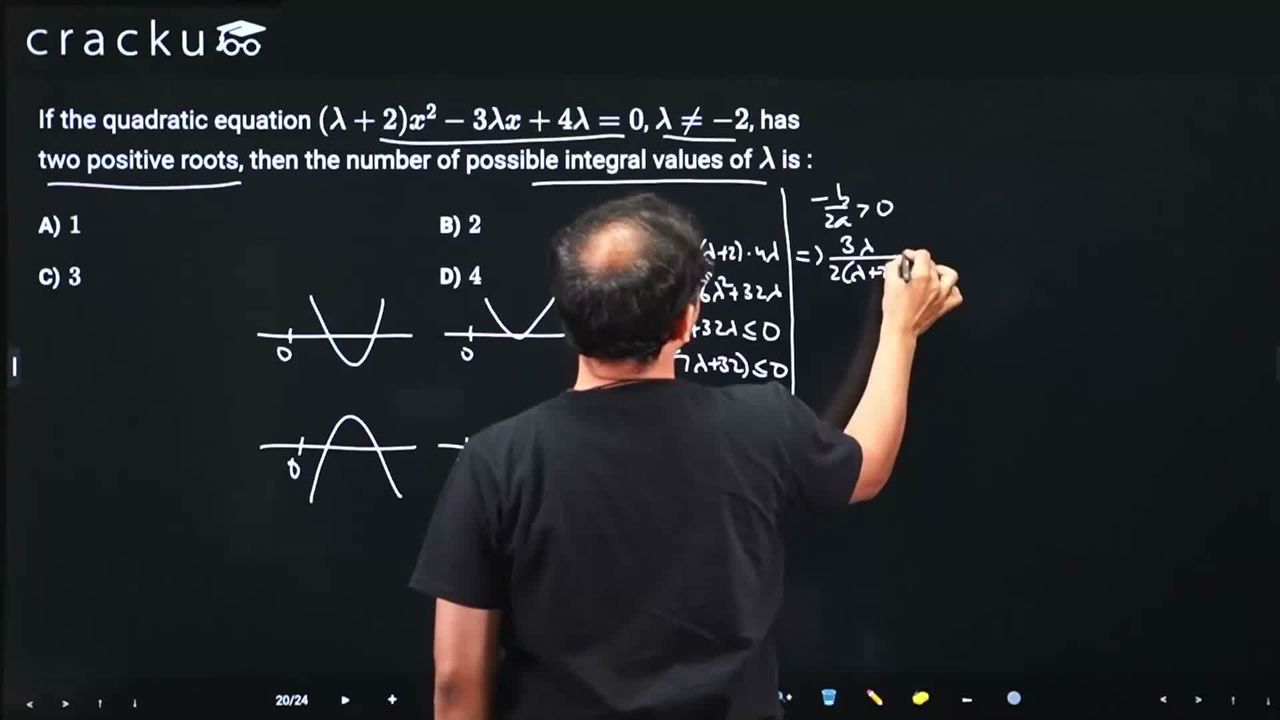
If the quadratic equation $$(\lambda + 2)x^2 - 3\lambda x + 4\lambda = 0$$, $$\lambda \neq -2$$, has two positive roots, then the number of possible integral values of $$\lambda$$ is :
For a quadratic equation $$Ax^2 + Bx + C = 0$$ to have two positive real roots ($$\alpha, \beta > 0$$), it must satisfy three conditions simultaneously:
Real Roots: The discriminant must be non-negative $$\implies D \ge 0$$
Positive Sum of Roots: $$\alpha + \beta = -\frac{B}{A} > 0$$
Positive Product of Roots: $$\alpha\beta = \frac{C}{A} > 0$$
Condition 1:
$$D = B^2 - 4AC = (-3\lambda)^2 - 4(\lambda + 2)(4\lambda) \ge 0$$
$$-7\lambda^2 - 32\lambda \ge 0$$
$$\lambda \in \left[-\frac{32}{7}, 0\right] \quad \text{--- (Inequality 1)}$$
Condition 2:
$$\alpha + \beta = \frac{3\lambda}{\lambda + 2} > 0$$
$$\lambda \in (-\infty, -2) \cup (0, \infty) \quad \text{--- (Inequality 2)}$$
Condition 3:
$$\alpha\beta = \frac{4\lambda}{\lambda + 2} > 0 \implies \frac{\lambda}{\lambda + 2} > 0$$
$$\lambda \in (-\infty, -2) \cup (0, \infty) \quad \text{--- (Inequality 3)}$$
Intersection: $$\lambda \in \left[-\frac{32}{7}, -2\right)$$
The integers that lie within the interval $$[-4.57, -2)$$ are $$\lambda = -4, -3$$
There are exactly $$2$$ possible integral values.
Was this solution helpful?
Click on the Email ☝️ to Watch the Video Solution
Create a FREE account and get:
_1.webp)

Educational materials for JEE preparation

Ask our AI anything

AI can make mistakes. Please verify important information.
AI can make mistakes. Please verify important information.
