
Join Our JEE Preparation Group
Prep with like-minded aspirants; Get access to free daily tests and study material.
Sign in
Please select an account to continue using cracku.in
↓ →
Join Our JEE Preparation Group
Prep with like-minded aspirants; Get access to free daily tests and study material.
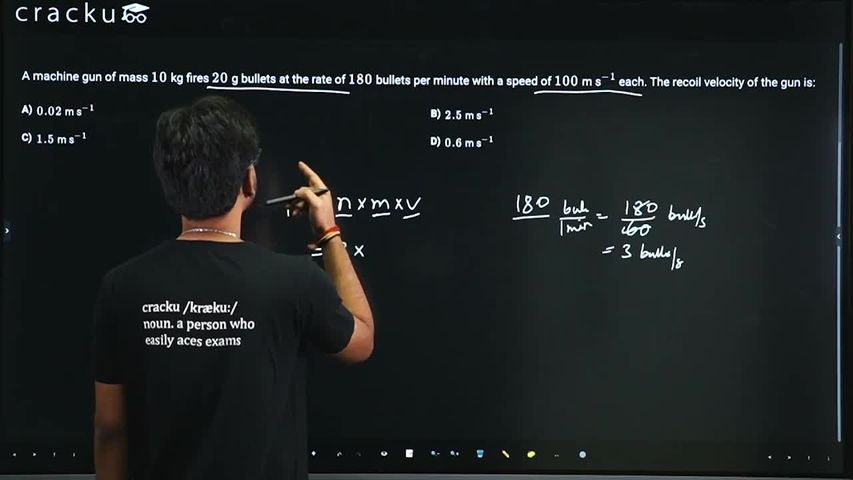
A machine gun of mass $$10$$ kg fires $$20$$ g bullets at the rate of $$180$$ bullets per minute with a speed of $$100$$ m s$$^{-1}$$ each. The recoil velocity of the gun is:
We are dealing with a recoil problem based on the Law of Conservation of Linear Momentum. Let us write down the given values from the system:
$$M = 10 \,\, \text{kg}$$
$$m = 20 \,\, \text{g} = \frac{20}{1000} \,\, \text{kg} = 0.02 \,\, \text{kg}$$
$$v = 100 \,\, \text{m s}^{-1}$$
$$n = \frac{180 \,\, \text{bullets}}{60 \,\, \text{seconds}} = 3 \,\, \text{bullets/s}$$
Initially, both the machine gun and the bullets are at rest, making the total initial momentum of the system equal to zero ($$P_{\text{initial}} = 0$$).
According to Newton's Third Law, the forward momentum imparted to the bullets every second must be perfectly balanced by the backward momentum gained by the gun every second to keep the total net momentum conserved ($$P_{\text{final}} = 0$$):
$$\text{Momentum gained by the gun per second} = \text{Momentum of bullets fired per second}$$
$$M \cdot V_{\text{recoil}} = n \cdot (m \cdot v)$$
Where $$V_{\text{recoil}}$$ is the backward recoil velocity of the machine gun.
Isolating the recoil velocity variable from the momentum balance equation:
$$V_{\text{recoil}} = \frac{n \cdot m \cdot v}{M}$$
Substituting our known structural values into the expression:
$$V_{\text{recoil}} = \frac{3 \cdot 0.02 \cdot 100}{10}$$
$$V_{\text{recoil}} = \frac{3 \cdot 2}{10}$$
$$V_{\text{recoil}} = \frac{6}{10} = 0.6 \,\, \text{m s}^{-1}$$
Correct Option Key: Option D (0.6 m s-1)
Was this solution helpful?
Click on the Email ☝️ to Watch the Video Solution
Create a FREE account and get:
_1.webp)

Educational materials for JEE preparation

Ask our AI anything

AI can make mistakes. Please verify important information.
AI can make mistakes. Please verify important information.
