
Join Our JEE Preparation Group
Prep with like-minded aspirants; Get access to free daily tests and study material.
Sign in
Please select an account to continue using cracku.in
↓ →
Join Our JEE Preparation Group
Prep with like-minded aspirants; Get access to free daily tests and study material.
The sum of the total number of bonds between chromium and oxygen atoms in chromate and dichromate ions is ___________.
Correct Answer: 12
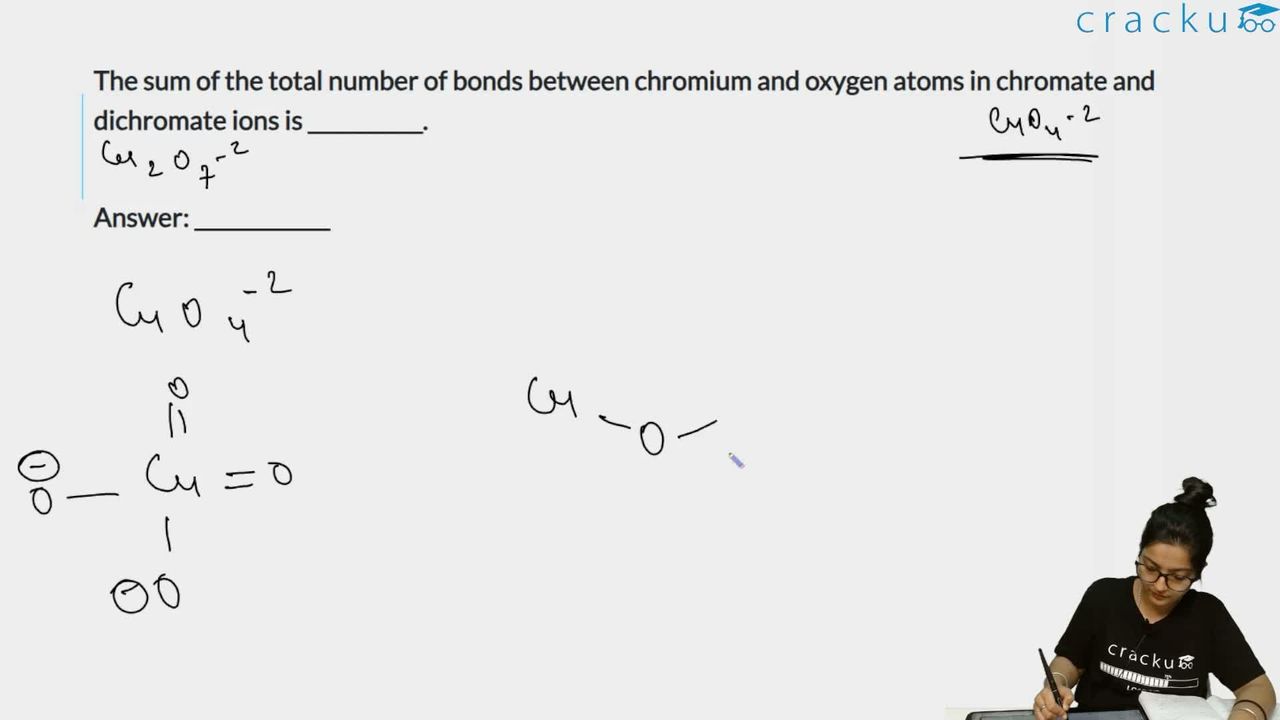
First, we consider the chromate ion, whose formula is $$\mathrm{CrO_4^{2-}}$$. The ion contains one chromium atom and four oxygen atoms. Every oxygen atom is directly bonded to the single chromium atom. So, counting each chromium-oxygen linkage once, we have
$$$\text{Number of Cr-O bonds in chromate } = 4.$$$
Now we turn to the dichromate ion, whose formula is $$\mathrm{Cr_2O_7^{2-}}$$. We can picture it as two $$\mathrm{CrO_4^{2-}}$$ tetrahedra that share one oxygen atom. This shared (bridging) oxygen links the two chromium atoms together. Let us count the chromium-oxygen bonds one by one.
Each chromium is still surrounded by four oxygen atoms. Three of those oxygens are terminal (they are bonded to only that one chromium), while the fourth oxygen is the single bridging atom that connects to both chromiums. Hence, looking at all the bonds emanating from the two chromiums, we have
$$$\begin{aligned} \text{Terminal Cr-O bonds } &= 2 \text{ chromiums}\times 3 \text{ bonds per chromium}=6,\\[2mm] \text{Bridging Cr-O bonds } &= 2 \text{ bonds} \;(\text{one from each Cr to the same O}).\\ \end{aligned}$$$
Adding these gives
$$$\text{Total Cr-O bonds in dichromate } = 6 + 2 = 8.$$$
Finally, the problem asks for the sum of the chromium-oxygen bonds in both ions. Therefore,
$$$\text{Required sum}= \underbrace{4}_{\text{chromate}} + \underbrace{8}_{\text{dichromate}} = 12.$$$
So, the answer is $$12$$.
Was this solution helpful?
Click on the Email ☝️ to Watch the Video Solution
Create a FREE account and get:
_1.webp)

Educational materials for JEE preparation

Ask our AI anything

AI can make mistakes. Please verify important information.
AI can make mistakes. Please verify important information.
