
Join Our JEE Preparation Group
Prep with like-minded aspirants; Get access to free daily tests and study material.
Sign in
Please select an account to continue using cracku.in
↓ →
Join Our JEE Preparation Group
Prep with like-minded aspirants; Get access to free daily tests and study material.
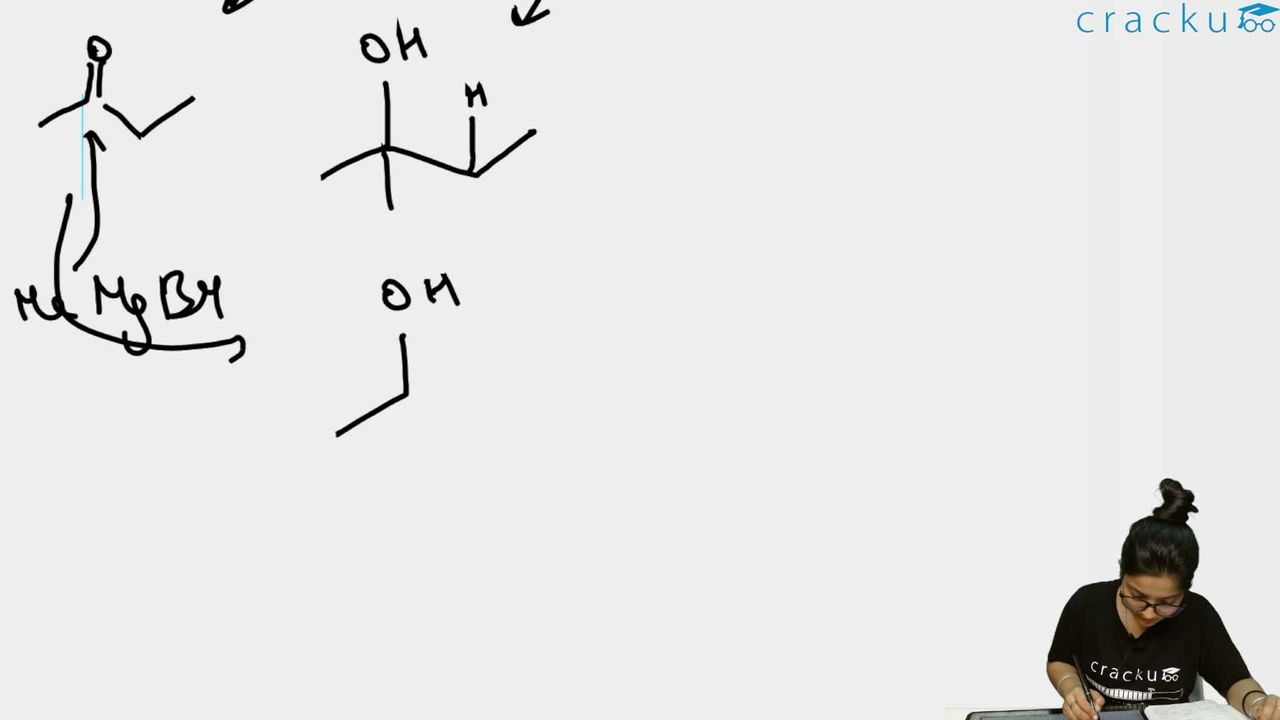
Consider the following reactions: $$A \xrightarrow[(ii)H_3O^+]{(i)CH_3MBr}B \xrightarrow[573K]{Cu} 2-methyl-2-butene$$. The mass percentage of carbon in A is ___________.
Correct Answer: 66.67
We have the sequence $$A \xrightarrow{\,(i)\;CH_3MBr\;(ii)\;H_3O^+}\;B \xrightarrow{Cu,\;573\,K}\;2\text{-methyl-2-butene}.$$
The second arrow tells us that on heating with copper at $$573\;K,$$ the compound $$B$$ loses a molecule of water to give the alkene 2-methyl-2-butene. It is well known (and you might have seen in your NCERT book) that tertiary alcohols on such heating undergo dehydration to alkenes. Therefore, $$B$$ must be a tertiary alcohol whose dehydration product is 2-methyl-2-butene.
2-methyl-2-butene has the skeleton
$$CH_3-C(CH_3)=CH-CH_3.$$ Removing the double bond and inserting an $$OH$$ group at the doubly bonded carbon gives the corresponding tertiary alcohol
$$CH_3-C(OH)(CH_3)-CH_2-CH_3,$$
which is 2-methyl-2-butan-2-ol (commonly written as 2-methyl-2-butanol). Hence
$$B = \text{2-methyl-2-butanol}.$$
Now we look at the first arrow. The reagent sequence $$(i)\;CH_3MBr\;(ii)\;H_3O^+$$ is the standard method for adding a methyl group from a Grignard reagent to a carbonyl compound and then protonating the alkoxide to an alcohol. In words:
Ketone/Aldehyde $$+$$ CH3MgBr $$\longrightarrow$$ alkoxide $$\xrightarrow{H_3O^+}$$ alcohol.
So, to obtain the tertiary alcohol $$B$$ we must start from a ketone whose carbonyl carbon already bears the two other groups seen in $$B,$$ namely $$CH_3$$ and $$CH_2CH_3.$$ Let us denote the unknown ketone by $$A.$$ If the carbonyl carbon of $$A$$ is attached to $$CH_3$$ and $$CH_2CH_3,$$ then the structure of $$A$$ is
$$CH_3-CO-CH_2-CH_3,$$
which is butan-2-one (methyl ethyl ketone). Addition of $$CH_3^-$$ from the Grignard reagent followed by acid work-up places an extra $$CH_3$$ on that carbon, giving exactly the tertiary alcohol $$B.$$ Therefore
$$A = \text{butan-2-one (CH}_3COCH_2CH_3).$$
Next we calculate the mass percentage of carbon in $$A.$$ First write its molecular formula:
Butan-2-one : $$C_4H_8O.$$
Molar mass calculation:
$$\text{Mass of }C = 4 \times 12\;\text{g mol}^{-1} = 48\;\text{g mol}^{-1},$$
$$\text{Mass of }H = 8 \times 1\;\text{g mol}^{-1} = 8\;\text{g mol}^{-1},$$
$$\text{Mass of }O = 1 \times 16\;\text{g mol}^{-1} = 16\;\text{g mol}^{-1}.$$
Total molar mass of $$A:$$ $$M = 48 + 8 + 16 = 72\;\text{g mol}^{-1}.$$
The formula for mass percentage is stated as $$\%\text{ element} = \frac{\text{mass of that element in 1 mole of compound}}{\text{molar mass of compound}}\times 100\%.$$
Applying it for carbon,
$$ \%C = \frac{48}{72}\times 100\% = 66.67\%. $$
So, the answer is $$66.67\%.$$
Was this solution helpful?
Click on the Email ☝️ to Watch the Video Solution
Create a FREE account and get:
_1.webp)

Educational materials for JEE preparation

Ask our AI anything

AI can make mistakes. Please verify important information.
AI can make mistakes. Please verify important information.
