
Join Our JEE Preparation Group
Prep with like-minded aspirants; Get access to free daily tests and study material.
Sign in
Please select an account to continue using cracku.in
↓ →
Join Our JEE Preparation Group
Prep with like-minded aspirants; Get access to free daily tests and study material.
A sample of milk splits after 60 min at 300K and after 40 min at 400K when the population of lactobacillus acidophilus in it doubles. The activation energy (in kJ/mol) for this process is closest to ___________.
(Given, $$R = 8.3$$ J mol$$^{-1}$$ K$$^{-1}$$, $$\ln\left(\frac{2}{3}\right) = 0.4$$, $$e^{-3} = 4.0$$)
Correct Answer: 3.98
We are told that the milk “splits” (curdles) exactly when the population of Lactobacillus acidophilus becomes double. A doubling time in a first-order growth process is related to the rate constant by the well-known relation
$$t_{\text{double}}=\dfrac{\ln 2}{k}\;.$$
So, if the doubling (splitting) time is known, the corresponding rate constant is
$$k=\dfrac{\ln 2}{t_{\text{double}}}\;.$$
The experiment gives
• at $$T_1 = 300\ \text{K}$$, splitting time $$t_1 = 60\ \text{min}$$,
• at $$T_2 = 400\ \text{K}$$, splitting time $$t_2 = 40\ \text{min}\;.$$
Using the formula above, the two rate constants are therefore
$$k_1=\dfrac{\ln 2}{t_1}= \dfrac{\ln 2}{60}\;,$$ $$k_2=\dfrac{\ln 2}{t_2}= \dfrac{\ln 2}{40}\;.$$
We next apply the Arrhenius equation, stated as
$$k = A\,e^{-E_a/(RT)},$$
where $$E_a$$ is the activation energy, $$R$$ the gas constant and $$A$$ the pre-exponential factor. Taking natural logarithms of both sides gives
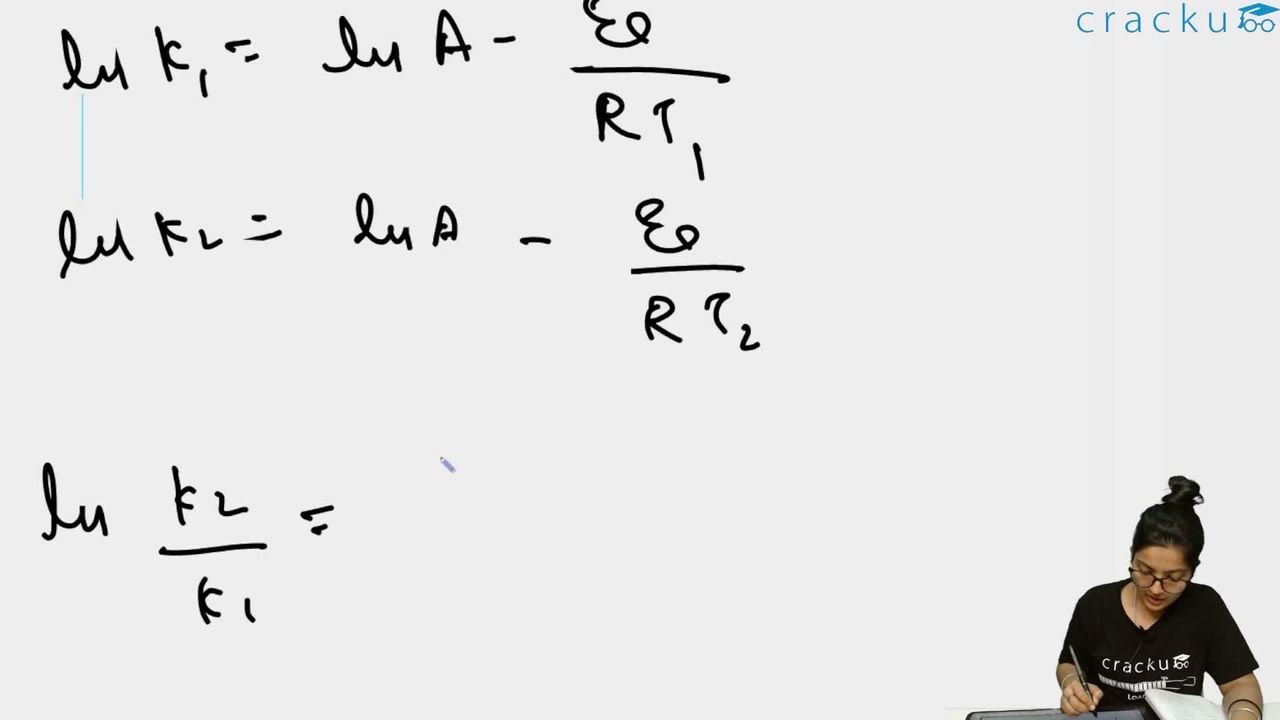
$$\ln k = \ln A - \dfrac{E_a}{R}\,\dfrac{1}{T}\;.$$
For two temperatures $$T_1$$ and $$T_2$$ this yields
$$\ln\dfrac{k_2}{k_1}= -\dfrac{E_a}{R}\Bigl(\dfrac{1}{T_2}-\dfrac{1}{T_1}\Bigr) = \dfrac{E_a}{R}\Bigl(\dfrac{1}{T_1}-\dfrac{1}{T_2}\Bigr).$$
We already have the ratio of rate constants:
$$\dfrac{k_2}{k_1}= \dfrac{\dfrac{\ln 2}{40}}{\dfrac{\ln 2}{60}} = \dfrac{60}{40}=1.5\;,$$ so that $$\ln\dfrac{k_2}{k_1}= \ln(1.5)\approx 0.4\;.$$ (The numerical hint $$\ln(2/3)=0.4$$ implies $$\ln(1.5)= -\ln(2/3)\approx 0.4$$.)
Now we evaluate the temperature term:
$$\dfrac{1}{T_1}-\dfrac{1}{T_2}= \dfrac{1}{300}-\dfrac{1}{400} =\dfrac{400-300}{300\times 400} =\dfrac{100}{120000} =\dfrac{1}{1200} = 0.0008333\ \text{K}^{-1}\;.$$
Substituting these two results into the Arrhenius relation gives
$$0.4=\dfrac{E_a}{R}\,(0.0008333).$$
Solving for $$E_a$$:
$$E_a = \dfrac{0.4 \times R}{0.0008333} = \dfrac{0.4 \times 8.3\ \text{J mol}^{-1}\text{K}^{-1}}{0.0008333}.$$ Straight multiplication gives $$0.4 \times 8.3 = 3.32\ \text{J mol}^{-1},$$ and finally $$E_a = \dfrac{3.32}{0.0008333}\ \text{J mol}^{-1} \approx 3.98\times10^{3}\ \text{J mol}^{-1}.$$ Converting joules to kilojoules, $$E_a \approx 3.98\ \text{kJ mol}^{-1}.$$
Hence, the correct answer is Option C.
Was this solution helpful?
Click on the Email ☝️ to Watch the Video Solution
Create a FREE account and get:
_1.webp)

Educational materials for JEE preparation

Ask our AI anything

AI can make mistakes. Please verify important information.
AI can make mistakes. Please verify important information.
