
Join Our JEE Preparation Group
Prep with like-minded aspirants; Get access to free daily tests and study material.
Sign in
Please select an account to continue using cracku.in
↓ →
Join Our JEE Preparation Group
Prep with like-minded aspirants; Get access to free daily tests and study material.
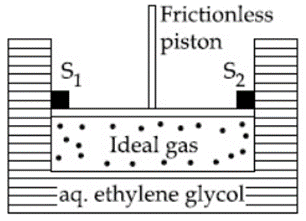
A cylinder containing an ideal gas (0.1 mol of 1.0 dm$$^3$$) is in thermal equilibrium with a large volume of 0.5 molal aqueous solution of ethylene glycol at its freezing point. If the stoppers $$S_1$$ and $$S_2$$ (as shown in the figure) are suddenly withdrawn, the volume of the gas in litres after equilibrium is achieved will be ___________.
(Given, $$K_f$$(water) $$= 2.0$$ K kg mol$$^{-1}$$, R $$= 0.08$$ dm$$^3$$ atm K$$^{-1}$$ mol$$^{-1}$$)
Correct Answer: 2.18
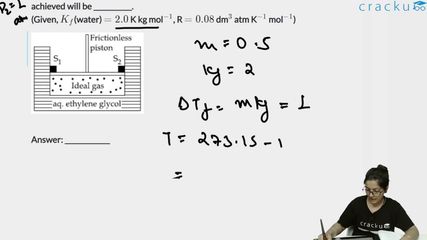
The problem states that the gas is in thermal equilibrium with a large volume of a $$0.5\text{ molal}$$ aqueous solution of ethylene glycol at its freezing point. We can find this temperature by calculating the depression in freezing point ($$\Delta T_f$$):
$$\Delta T_f = K_f \cdot m$$
Where:
$$\Delta T_f = 2.0 \times 0.5 = 1.0\text{ K}$$
Since the normal freezing point of pure water is $$273.15\text{ K}$$, the freezing point of the solution (and thus the temperature of the system) is:
$$T = 273.15\text{ K} - 1.0\text{ K} = 272.15\text{ K}$$
The diagram shows a frictionless piston open to the atmosphere. When the stoppers $$S_1$$ and $$S_2$$ are withdrawn, the piston is free to move up or down until the internal pressure of the gas perfectly balances the external atmospheric pressure.
Therefore, at final equilibrium, the pressure of the gas is equal to standard atmospheric pressure:
$$P_2 = 1\text{ atm}$$
Now, we apply the ideal gas equation ($$P_2 V_2 = nRT$$) to isolate and solve for the final volume $$V_2$$:
$$V_2 = \frac{nRT}{P_2}$$
Substitute the given parameters:
$$V_2 = \frac{0.1 \times 0.08 \times 272.15}{1}$$
$$V_2 = 0.008 \times 272.15 = 2.1772\text{ dm}^3$$
Since $$1\text{ dm}^3 = 1\text{ Litre}$$, the volume of the gas is approximately $$2.18\text{ Litres}$$.
The withdrawal of the stoppers allows the gas to expand against the constant atmospheric pressure until it hits equilibrium at $$2.18\text{ L}$$.
Answer: 2.18
Was this solution helpful?
Click on the Email ☝️ to Watch the Video Solution
Create a FREE account and get:
_1.webp)

Educational materials for JEE preparation

Ask our AI anything

AI can make mistakes. Please verify important information.
AI can make mistakes. Please verify important information.
