
Join Our JEE Preparation Group
Prep with like-minded aspirants; Get access to free daily tests and study material.
Sign in
Please select an account to continue using cracku.in
↓ →
Join Our JEE Preparation Group
Prep with like-minded aspirants; Get access to free daily tests and study material.
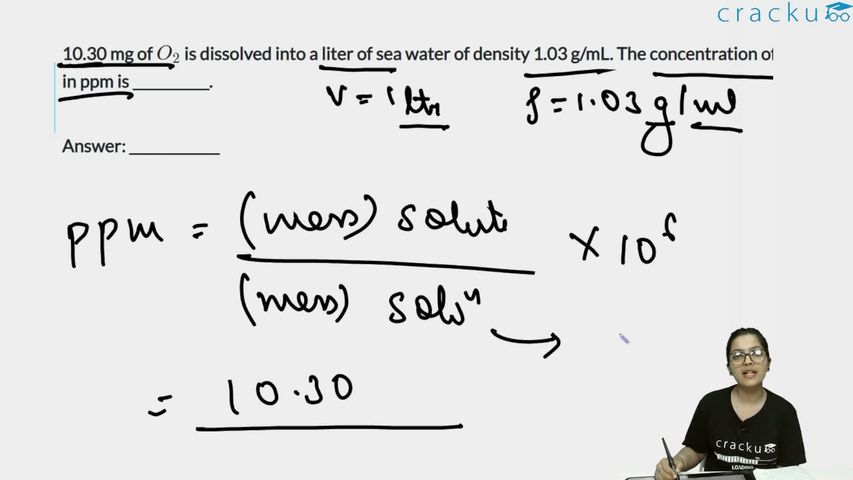
10.30 mg of $$O_2$$ is dissolved into a liter of sea water of density 1.03 g/mL. The concentration of $$O_2$$ in ppm is ___________.
Correct Answer: 10
We first recall the definition of parts per million (ppm). By definition,
$$\text{ppm}=\frac{\text{mass of solute}}{\text{mass of solution}}\times10^{6}.$$
Here the solute is the dissolved oxygen, and the solution is the sea water (whose mass will be calculated from its density and volume). Let us proceed step by step.
The mass of dissolved oxygen given is
$$m_{\text{O}_2}=10.30\ \text{mg}.$$
We are told that one litre of sea water is used. The density of sea water is
$$\rho_{\text{sea water}} = 1.03\ \text{g mL}^{-1}.$$
Since one litre equals $$1000\ \text{mL}$$, the mass of this volume of sea water is obtained from the density formula
$$\text{mass} = \rho \times \text{volume}.$$
Substituting the given values gives
$$m_{\text{sea water}} = (1.03\ \text{g mL}^{-1})(1000\ \text{mL}) = 1030\ \text{g}.$$
To keep the numerator and denominator in the same units, let us convert this mass into milligrams. We use the relation $$1\ \text{g}=1000\ \text{mg}.$$ Thus,
$$m_{\text{sea water}} = 1030\ \text{g}\times1000\ \frac{\text{mg}}{\text{g}} = 1\,030\,000\ \text{mg}.$$
Now we substitute these masses into the ppm formula:
$$ \text{ppm} = \frac{m_{\text{O}_2}}{m_{\text{sea water}}}\times10^{6} = \frac{10.30\ \text{mg}}{1\,030\,000\ \text{mg}}\times10^{6}. $$
We can simplify step by step. First divide the masses:
$$ \frac{10.30}{1\,030\,000} = 1.00097\times10^{-5}. $$
Now multiply by $$10^{6}$$:
$$ 1.00097\times10^{-5}\times10^{6} = 1.00097\times10^{1} = 10.0097. $$
Rounding this to an appropriate number of significant figures (the original data are given to three significant figures), we obtain
$$\text{ppm} \approx 10.0.$$
So, the answer is $$10$$.
Was this solution helpful?
Click on the Email ☝️ to Watch the Video Solution
Create a FREE account and get:
_1.webp)

Educational materials for JEE preparation

Ask our AI anything

AI can make mistakes. Please verify important information.
AI can make mistakes. Please verify important information.
