
Join Our JEE Preparation Group
Prep with like-minded aspirants; Get access to free daily tests and study material.
Sign in
Please select an account to continue using cracku.in
↓ →
Join Our JEE Preparation Group
Prep with like-minded aspirants; Get access to free daily tests and study material.
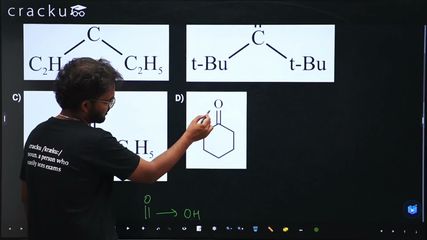
Which of the following ketone will NOT give enamine on treatment with secondary amines? [where t-Bu is $$-C(CH_3)_3$$]
Explanation: Enamine formation requires removal of an $$\mathrm{\alpha}$$-hydrogen from the carbon adjacent to the carbonyl group in the final dehydration step.
Therefore, a ketone must contain at least one $$\mathrm{\alpha}$$-hydrogen to form an enamine.
In di-$$\mathrm{tert}$$-butyl ketone, the $$\mathrm{\alpha}$$-carbon is bonded to three methyl groups and the carbonyl carbon, $$\mathrm{-C(CH_3)_3}$$.
Thus, the $$\mathrm{\alpha}$$-carbon contains no hydrogen atoms.
Because no $$\mathrm{\alpha}$$-hydrogen is available, formation of the required $$\mathrm{C=C}$$ bond is impossible.
Hence, di-$$\mathrm{tert}$$-butyl ketone cannot form an enamine.
Ketones such as diethyl ketone and cyclohexanone possess $$\mathrm{\alpha}$$-hydrogens and therefore readily form enamines.
Correct Option: $$\mathrm{(B)}$$
Was this solution helpful?
Click on the Email ☝️ to Watch the Video Solution
Create a FREE account and get:
_1.webp)

Educational materials for JEE preparation

Ask our AI anything

AI can make mistakes. Please verify important information.
AI can make mistakes. Please verify important information.


