
Join Our JEE Preparation Group
Prep with like-minded aspirants; Get access to free daily tests and study material.
Sign in
Please select an account to continue using cracku.in
↓ →
Join Our JEE Preparation Group
Prep with like-minded aspirants; Get access to free daily tests and study material.
Match List - I with List - II.
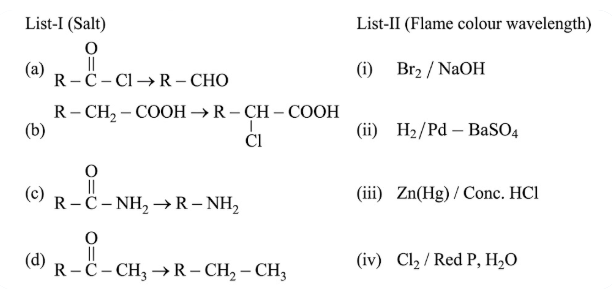
Choose the correct answer from the options given below:
Reaction $$\mathrm{(a)}$$ converts an acid chloride $$\mathrm{(RCOCl)}$$ into an aldehyde $$\mathrm{(RCHO)}$$. This reaction is called the $$\mathrm{Rosenmund\ Reduction}$$ and uses $$\mathrm{H_2/Pd-BaSO_4}$$. Hence, $$\mathrm{(a)\rightarrow(ii)}$$.
Reaction $$\mathrm{(b)}$$ involves $$\mathrm{\alpha}$$-halogenation of a carboxylic acid $$\mathrm{(RCH_2COOH \rightarrow RCH(Cl)COOH)}$$. This is the $$\mathrm{Hell\text{-}Volhard\text{-}Zelinsky\ Reaction}$$ and uses $$\mathrm{Cl_2/Red\ P,\ H_2O}$$. Hence, $$\mathrm{(b)\rightarrow(iv)}$$.
Reaction $$\mathrm{(c)}$$ converts a primary amide $$\mathrm{(RCONH_2)}$$ into a primary amine $$\mathrm{(RNH_2)}$$ with loss of one carbon atom. This is the $$\mathrm{Hoffmann\ Bromamide\ Degradation}$$ and uses $$\mathrm{Br_2/NaOH}$$. Hence, $$\mathrm{(c)\rightarrow(i)}$$.
Reaction $$\mathrm{(d)}$$ reduces a ketone carbonyl group $$\mathrm{(RCOCH_3)}$$ into $$\mathrm{RCH_2CH_3}$$. This is the $$\mathrm{Clemmensen\ Reduction}$$ and uses $$\mathrm{Zn(Hg)/Conc.\ HCl}$$. Hence, $$\mathrm{(d)\rightarrow(iii)}$$.
Therefore, the correct matching is $$\mathrm{(a)\rightarrow(ii),\ (b)\rightarrow(iv),\ (c)\rightarrow(i),\ (d)\rightarrow(iii)}$$.
Correct Option: $$\mathrm{A}$$
Was this solution helpful?
Create a FREE account and get:
_1.webp)

Educational materials for JEE preparation

Ask our AI anything

AI can make mistakes. Please verify important information.
AI can make mistakes. Please verify important information.


