Join Our JEE Preparation Group
Prep with like-minded aspirants; Get access to free daily tests and study material.
Sign in
Please select an account to continue using cracku.in
↓ →
Join Our JEE Preparation Group
Prep with like-minded aspirants; Get access to free daily tests and study material.
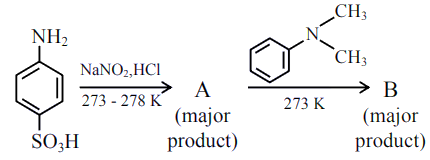
When $$\mathrm{N,N\text{-}dimethylaniline}$$ is used instead of aniline in the coupling reaction with benzenediazonium chloride, an azo coupling reaction occurs.
The reaction is:
$$\mathrm{C_6H_5N_2^+Cl^- + C_6H_5N(CH_3)_2 \xrightarrow{H^+} C_6H_5-N=N-C_6H_4N(CH_3)_2 + HCl}$$
The diazonium ion acts as a weak electrophile and attacks the activated aromatic ring of $$\mathrm{N,N\text{-}dimethylaniline}$$.
The $$\mathrm{-N(CH_3)_2}$$ group is strongly activating and:
$$\mathrm{ortho/para\ directing}$$
Due to lower steric hindrance, substitution occurs mainly at the para position.
Thus, the product formed is:
$$\mathrm{p\text{-}(N,N\text{-}dimethylamino)azobenzene}$$
The final azo dye retains the two methyl groups attached to nitrogen.
This compound is commonly known as:
$$\mathrm{Butter\ Yellow}$$
which is a brightly coloured azo dye.
Was this solution helpful?
Create a FREE account and get:
_1.webp)

Educational materials for JEE preparation

Ask our AI anything

AI can make mistakes. Please verify important information.
AI can make mistakes. Please verify important information.