
Join Our JEE Preparation Group
Prep with like-minded aspirants; Get access to free daily tests and study material.
Sign in
Please select an account to continue using cracku.in
↓ →
Join Our JEE Preparation Group
Prep with like-minded aspirants; Get access to free daily tests and study material.
Two solutions, A and B, each of 100L was made by dissolving 4g of NaOH and 9.8g of H$$_2$$SO$$_4$$ in water, respectively. The pH of the resultant solution obtained from mixing 40L of solution A and 10L of solution B is (log 2 = 0.3)
Correct Answer: 10.6
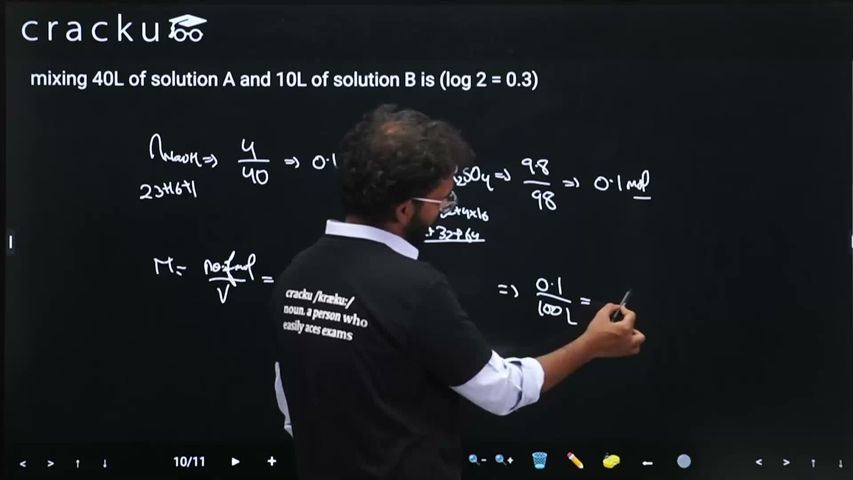
We have solution A prepared by dissolving 4 g of NaOH in 100 L of water. The molar mass of NaOH is $$23 + 16 + 1 = 40\ \text{g mol}^{-1}.$$ Hence, the moles of NaOH present in solution A are
$$n_{\text{NaOH}} = \frac{4\ \text{g}}{40\ \text{g mol}^{-1}} = 0.1\ \text{mol}.$$
The volume is 100 L, so the molarity of NaOH in solution A is
$$[\text{NaOH}]_A = \frac{0.1\ \text{mol}}{100\ \text{L}} = 0.001\ \text{M}.$$
Next, solution B is prepared by dissolving 9.8 g of H$$_2$$SO$$_4$$ in 100 L of water. The molar mass of H$$_2$$SO$$_4$$ is $$2(1) + 32 + 4(16) = 98\ \text{g mol}^{-1}.$$ Thus, the moles of acid in solution B are
$$n_{\text{H}_2\text{SO}_4} = \frac{9.8\ \text{g}}{98\ \text{g mol}^{-1}} = 0.1\ \text{mol}.$$
Therefore, the molarity of H$$_2$$SO$$_4$$ in solution B is
$$[\text{H}_2\text{SO}_4]_B = \frac{0.1\ \text{mol}}{100\ \text{L}} = 0.001\ \text{M}.$$
Now we mix 40 L of solution A with 10 L of solution B.
Moles of NaOH taken from solution A:
$$n_{\text{NaOH,mix}} = 0.001\ \text{M} \times 40\ \text{L} = 0.04\ \text{mol}.$$
Moles of H$$_2$$SO$$_4$$ taken from solution B:
$$n_{\text{H}_2\text{SO}_4,\text{mix}} = 0.001\ \text{M} \times 10\ \text{L} = 0.01\ \text{mol}.$$
The neutralisation reaction is $$2\ \text{NaOH} + \text{H}_2\text{SO}_4 \rightarrow \text{Na}_2\text{SO}_4 + 2\ \text{H}_2\text{O}.$$ From the stoichiometry, 1 mol of H$$_2$$SO$$_4$$ requires 2 mol of NaOH.
NaOH required to neutralise 0.01 mol of H$$_2$$SO$$_4$$:
$$n_{\text{NaOH,needed}} = 2 \times 0.01 = 0.02\ \text{mol}.$$
We actually have 0.04 mol of NaOH, so the excess (unreacted) NaOH is
$$n_{\text{NaOH,excess}} = 0.04 - 0.02 = 0.02\ \text{mol}.$$
The total volume after mixing is
$$V_{\text{total}} = 40\ \text{L} + 10\ \text{L} = 50\ \text{L}.$$
Hence, the concentration of excess OH$$^-$$ ions is
$$[\text{OH}^-] = \frac{0.02\ \text{mol}}{50\ \text{L}} = 0.0004\ \text{M} = 4 \times 10^{-4}\ \text{M}.$$
Using the definition $$\text{pOH} = -\log[\text{OH}^-],$$ we get
$$\text{pOH} = -\log(4 \times 10^{-4}).$$
First, write $$\log(4 \times 10^{-4}) = \log 4 + \log 10^{-4}.$$ We know $$\log 10^{-4} = -4$$ and $$\log 4 = \log(2^2) = 2\log 2 = 2(0.3) = 0.6.$$ So,
$$\log(4 \times 10^{-4}) = 0.6 - 4 = -3.4.$$
Therefore, $$\text{pOH} = -(-3.4) = 3.4.$$
For water at 25 °C, $$\text{pH} + \text{pOH} = 14.$$ Substituting the pOH value,
$$\text{pH} = 14 - 3.4 = 10.6.$$
So, the answer is $$10.6$$.
Was this solution helpful?
Click on the Email ☝️ to Watch the Video Solution
Create a FREE account and get:
_1.webp)

Educational materials for JEE preparation

Ask our AI anything

AI can make mistakes. Please verify important information.
AI can make mistakes. Please verify important information.


