
Join Our JEE Preparation Group
Prep with like-minded aspirants; Get access to free daily tests and study material.
Sign in
Please select an account to continue using cracku.in
↓ →
Join Our JEE Preparation Group
Prep with like-minded aspirants; Get access to free daily tests and study material.
For the reaction:
A(l) $$\rightarrow$$ 2B(g)
$$\Delta U = 2.1$$ kcal, $$\Delta S = 20$$ cal K$$^{-1}$$ at 300K.
Hence $$\Delta G$$ in kcal is
Correct Answer: -2.7
For the chemical change
$$\mathrm{A(l)\; \rightarrow\; 2B(g)}$$
we are supplied with the following data per mole of reaction:
$$\Delta U = 2.1\ \text{kcal}, \qquad \Delta S = 20\ \text{cal K}^{-1}, \qquad T = 300\ \text{K}$$
First, we convert every quantity to consistent energy units. Because enthalpy and free-energy changes will finally be expressed in kilocalories, the entropy must also be written in kilocalories:
$$\Delta S = 20\ \text{cal K}^{-1} = \frac{20}{1000}\ \text{kcal K}^{-1} = 0.020\ \text{kcal K}^{-1}$$
Next, we recall the thermodynamic relation that connects the change in internal energy $$\Delta U$$ with the change in enthalpy $$\Delta H$$ for a reaction that involves gases:
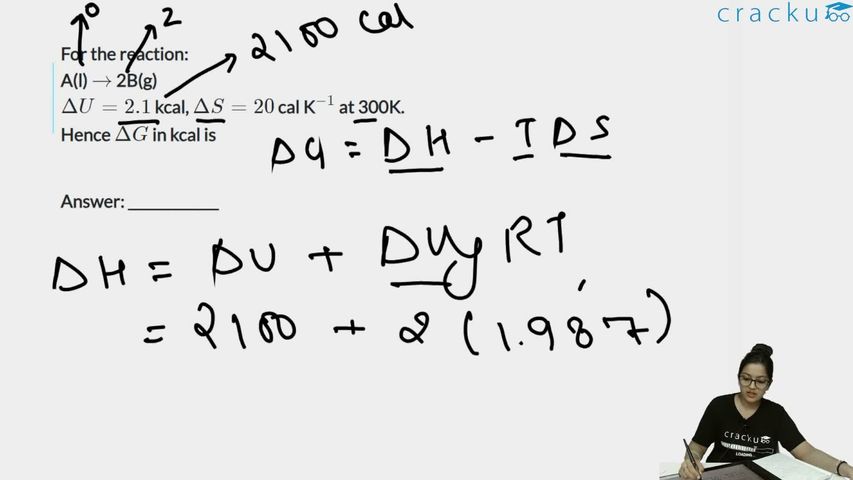
$$\Delta H = \Delta U + \Delta n_{\text{gas}}\, R\, T$$
Here, $$\Delta n_{\text{gas}}$$ denotes the difference between moles of gaseous products and gaseous reactants. In the present reaction the reactant is a liquid, so it contributes no gaseous moles, while the product side has two moles of gas:
$$\Delta n_{\text{gas}} = 2 - 0 = 2$$
The universal gas constant in kilocalorie units is
$$R = 1.987\ \text{cal K}^{-1}\text{mol}^{-1} = 0.001987\ \text{kcal K}^{-1}\text{mol}^{-1}$$
Now we compute the additional term $$\Delta n_{\text{gas}} R T$$:
$$R\,T = 0.001987\ \text{kcal K}^{-1}\!\times\!300\ \text{K} = 0.5961\ \text{kcal}$$
$$\Delta n_{\text{gas}}\,R\,T = 2 \times 0.5961\ \text{kcal} = 1.1922\ \text{kcal}$$
Substituting in the equation for $$\Delta H$$, we obtain
$$\Delta H = 2.1\ \text{kcal} + 1.1922\ \text{kcal} = 3.2922\ \text{kcal}$$
Having found $$\Delta H$$, we turn to Gibbs free energy. The fundamental expression is
$$\Delta G = \Delta H - T\,\Delta S$$
We already possess $$\Delta H$$, $$T = 300\ \text{K}$$, and $$\Delta S = 0.020\ \text{kcal K}^{-1}$$, so
$$T\,\Delta S = 300\ \text{K}\!\times\!0.020\ \text{kcal K}^{-1} = 6.0\ \text{kcal}$$
Now we evaluate $$\Delta G$$:
$$\Delta G = 3.2922\ \text{kcal} - 6.0\ \text{kcal} = -2.7078\ \text{kcal}$$
Rounded to two significant figures,
$$\Delta G \approx -2.7\ \text{kcal}$$
So, the answer is $$-2.7\ \text{kcal}$$.
Was this solution helpful?
Click on the Email ☝️ to Watch the Video Solution
Create a FREE account and get:
_1.webp)

Educational materials for JEE preparation

Ask our AI anything

AI can make mistakes. Please verify important information.
AI can make mistakes. Please verify important information.


