
Join Our JEE Preparation Group
Prep with like-minded aspirants; Get access to free daily tests and study material.
Sign in
Please select an account to continue using cracku.in
↓ →
Join Our JEE Preparation Group
Prep with like-minded aspirants; Get access to free daily tests and study material.
During the nuclear explosion, one of the products is $$^{90}$$Sr with half life of 6.93 years. If 1$$\mu$$g of $$^{90}$$Sr was absorbed in the bones of a newly born baby in place of Ca, how much time, in years, is required to reduce it by 90% if it is not lost metabolically
Correct Answer: 23.03
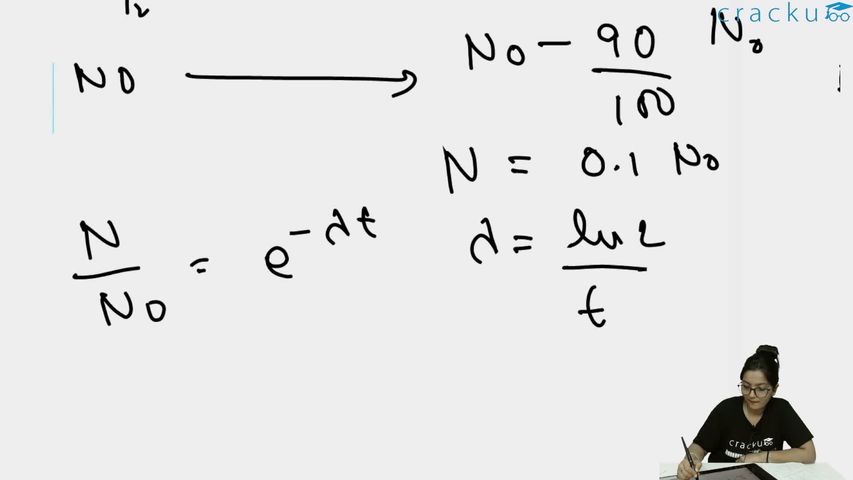
The radioactive decay of any nuclide is governed by the exponential law
$$N \;=\; N_0\,e^{-\lambda t},$$
where $$N_0$$ is the initial number of nuclei, $$N$$ is the number left after time $$t$$, and $$\lambda$$ is the decay constant.
It is often more convenient to write this law using the half-life $$T_{1/2}$$. The relationship between the decay constant and the half-life is
$$\lambda \;=\; \frac{\ln 2}{T_{1/2}}.$$
Eliminating $$\lambda$$ from the first equation gives the form that directly involves the half-life:
$$N \;=\; N_0\Bigl(\tfrac12\Bigr)^{t/T_{1/2}}.$$
In the present problem we are told that the half-life of $$^{90}\text{Sr}$$ is $$T_{1/2}=6.93\text{ yr}$$. A newborn baby absorbs an initial mass of $$1\,\mu\text{g}$$ of this isotope. We are asked how long it will take for this quantity to drop by 90 %, that is, for only 10 % of the original amount to remain.
Mathematically, “drop by 90 %’’ means
$$\frac{N}{N_0}=0.10.$$
Substituting this fraction and the given half-life into the decay equation, we have
$$0.10 \;=\;\Bigl(\tfrac12\Bigr)^{t/6.93}.$$
To solve for $$t$$ we take the natural logarithm of both sides:
$$\ln(0.10) \;=\; \ln\!\Bigl[\Bigl(\tfrac12\Bigr)^{t/6.93}\Bigr].$$
Using the property $$\ln(a^b)=b\,\ln a$$, the right-hand side simplifies:
$$\ln(0.10) \;=\; \frac{t}{6.93}\,\ln\!\Bigl(\tfrac12\Bigr).$$
Now we isolate $$t$$:
$$t \;=\; 6.93 \times \frac{\ln(0.10)}{\ln(1/2)}.$$
Both logarithms are negative, so their ratio is positive. We calculate them explicitly:
$$\ln(0.10) = -2.302585093,\qquad \ln\!\Bigl(\tfrac12\Bigr) = -0.693147181.$$
Dividing gives
$$\frac{\ln(0.10)}{\ln(1/2)} = \frac{-2.302585093}{-0.693147181} = 3.321928094.$$
Multiplying by 6.93 yr, we find
$$t = 6.93 \times 3.321928094 = 23.02296\text{ yr}.$$
Rounding appropriately, the required time is
$$t \;\approx\; 23.03\text{ years}.$$
So, the answer is $$23.03\text{ years}$$.
Was this solution helpful?
Click on the Email ☝️ to Watch the Video Solution
Create a FREE account and get:
_1.webp)

Educational materials for JEE preparation

Ask our AI anything

AI can make mistakes. Please verify important information.
AI can make mistakes. Please verify important information.


